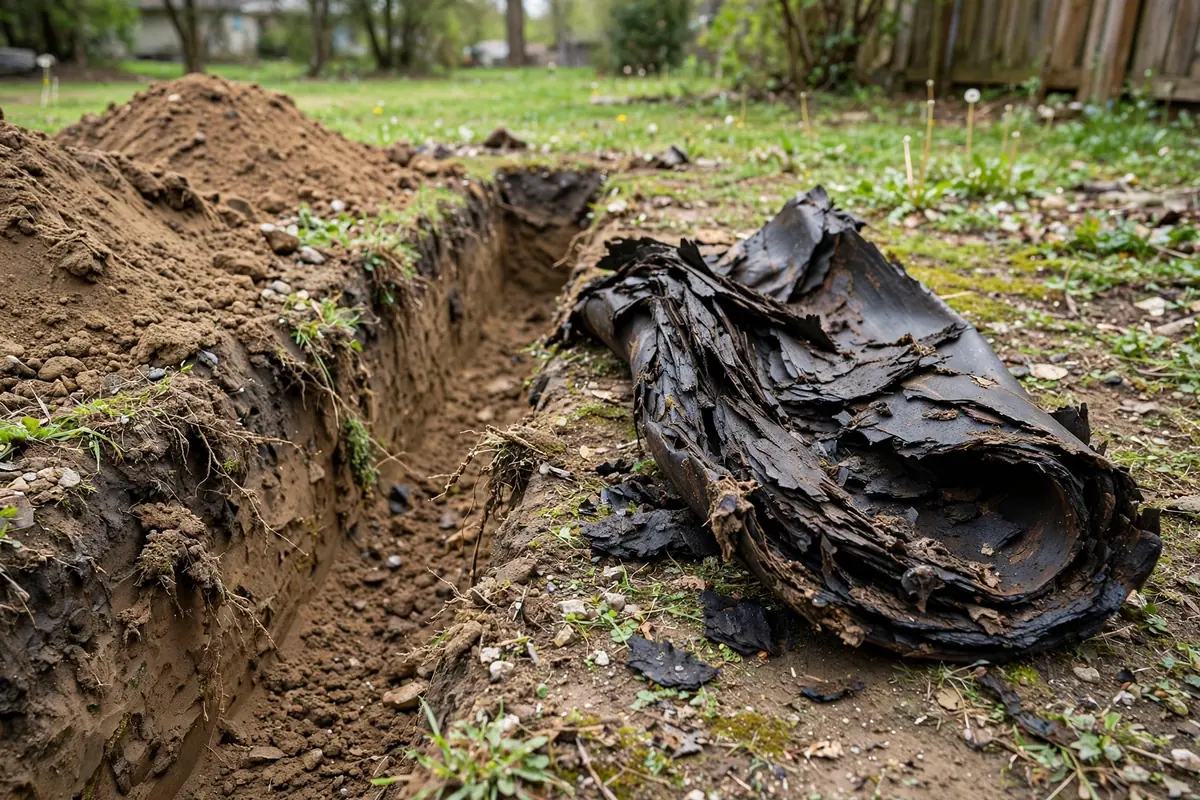
Does Homeowners Insurance Cover Sewer Line Repair? Service Line Coverage Explained

Free Call · Answered 24/7 · Local Pros Near You
The Short Answer
For most homeowners, no — a standard homeowners policy usually does not pay to repair or replace the sewer line itself. The pipe from your home to the street is normally yours to maintain. Two different add-ons can change that: service line coverage, which can pay for damage to the buried pipe, and a water or sewer backup endorsement, which pays for damage inside your home after a backup. The two cover different things.
Call (800) 555-0100Sewer Line Insurance Coverage, Explained In Plain Words
What Does A Standard Homeowners Policy Actually Cover?
A standard policy covers sudden damage inside your home from a covered event, but it normally excludes the buried lateral itself and wear that builds up over years. Roots, corrosion and slow collapse are treated as maintenance, not accidents.
Your sewer lateral (building sewer) is the pipe that carries wastewater from your home to the public sewer main in New York streets and in towns across the state. In most places that whole run, from the foundation wall to the main, belongs to the homeowner. When it cracks, sags or fills with roots, a standard policy usually sees upkeep that was left undone, not a sudden loss.
That split surprises people. If a pipe inside the house bursts and ruins a floor, the inside damage may be covered. If the buried line outside breaks, the digging, the pipe work and putting the yard back are usually on you unless you bought extra cover. Policies also commonly exclude damage from long-term leaks, settling and tree root intrusion, because those develop slowly rather than in one sudden event.
Read the exclusions part of your policy before you assume anything. Look for words like service line, utility line, water backup and sewer backup. If none of them appear as added cover, the safe working assumption is that the pipe itself is your cost and only certain kinds of indoor water damage might be paid.
What Is Service Line Coverage?
Service line coverage is an optional add-on that can pay to repair or replace your own buried lines, including the lateral, when they fail from things like wear, roots, corrosion or collapse. It is the add-on that speaks to the pipe itself.
Insurers sell it as an endorsement added to a homeowners policy, or sometimes as a separate plan. It typically covers the cost to dig up or trenchlessly repair the damaged section, replace pipe that has failed, and restore the ground above it. For example, homeowners reading about sewer line repair in Albany, NY often find their older clay or cast iron lateral is exactly the kind of line this endorsement was written for.
The failures it names matter. A line that wears out, cracks under soil pressure, is crushed by roots or corrodes through is the usual picture. Damage you cause yourself, or a line that was already known to be failing before the cover started, is commonly excluded. There is normally a limit per claim and a deductible, and both vary by policy, so check the numbers on your own documents rather than going by a neighbour's plan.
State insurance departments oversee these products. In New York that is the New York State Department of Financial Services, in Ohio the Ohio Department of Insurance, and in Pennsylvania the Pennsylvania Insurance Department. Their consumer pages explain endorsements in plain terms and are a sound place to check what an add-on should and should not do.
How Is Sewer Backup Coverage Different?
Sewer backup coverage pays for damage inside your home when sewage or drain water backs up into it. It does not pay to fix the pipe that caused the backup. Service line coverage and backup coverage solve two different problems.
Picture a blocked lateral on a rainy night. Sewage rises through the basement floor drain and ruins flooring, stored boxes and a water heater. A backup endorsement is about that indoor damage: cleanup, damaged items and repairs to the room, up to its limit. The blocked pipe outside still needs its own repair, and that bill sits with you unless service line coverage applies.
Many homes have one endorsement and not the other, because they are sold separately and named in confusingly similar ways. Our separate guide on service line coverage vs sewer backup coverage walks through the wording side by side. Homeowners dealing with a sewer line problem in Akron, OH run into this gap often: the cleanup was covered, the pipe was not, and nobody had explained the difference beforehand.
A backwater valve, a one-way fitting on the line, can reduce how often sewage flows back into the house, and some insurers look kindly on one. It is prevention, though, not coverage. It does not repair a cracked pipe, and it does not change what your policy pays.
What Does A Sewer Line Claim Need?
A claim usually needs proof of what failed, where, and why. Clear camera footage, a written inspection report and dated photos give the insurer something solid to judge, and they are the same records a good pro creates before any digging starts.
Start with a CCTV sewer camera inspection. The camera travels the line from the sewer cleanout and shows cracks, roots, a belly or sag in the line, an offset joint, or a cracked or collapsed pipe, with distance readings. Keep the sewer inspection report and footage the pro hands you, plus still photos of any sewage damage inside the home and the dates you first noticed slow drains or odours.
This page is about whether cover exists in the first place. The step-by-step paperwork of filing, what to send and in what order, is covered on its own page about claim documents, because that is a big topic on its own. The short version here: do not authorise a full replacement before you know whether the insurer wants to see the line first, and keep every invoice, report and photo together in one folder.
One more habit helps. Photograph the yard and driveway before any excavation, and keep the old pipe sections if the insurer asks to see them. Small records like that settle arguments about what was damaged and what the work actually involved.
What Affects The Cost Of Repair?
The repair bill turns on the pipe, the ground and the method — never on one flat figure. Material, depth, length, access and whether a trenchless method can be used shape the quote more than anything else.
Material comes first. A vitrified clay pipe with roots at every joint, a cast iron pipe eaten thin by corrosion, and an Orangeburg pipe that has gone oval all fail in different ways and allow different fixes. Orangeburg is the hard case: as our guide to Orangeburg sewer pipe explains, lining rarely saves it because the host pipe has lost its round shape.
Method comes next. Cured-in-place pipe lining (CIPP) renews a line from inside where the old pipe still holds its shape. Pipe bursting pulls a new pipe through the old one. Open-trench replacement digs the full run and suits collapsed lines, but costs more in digging and in putting back driveways, paths and planting. Hydro jetting and root cutting only clean a line; they are cheaper because they change nothing structural.
Access and ground finish the picture: how deep the line sits, how far it runs, whether it passes under concrete, and whether the proper slope and grade of a sewer line can be kept. That is why a pro in a place like Allentown, PA, for sewer line help will scope the line before quoting. Anyone quoting blind is guessing with your money.
When Should You Check Your Policy?
Check your policy before you have a problem, not during one. The clear moments are when you buy a home, when you renew, and whenever you learn your line is old, shared or made of a material that is near the end of its life.
Older homes deserve the closest look. If your house was built before 1980, its lateral may be clay, cast iron or Orangeburg, all of which are now decades into their working lives. A pre-purchase sewer scope before you buy shows the line's real condition while you can still act on the finding, and it pairs naturally with asking the insurer what a service line endorsement would add.
Small towns are not exempt. Homeowners arranging sewer line repair in Accord, NY face the same policy wording as city owners, because the endorsement terms come from the insurer, not the town. Wherever you live, ask three direct questions: does my policy include service line coverage, does it include sewer backup coverage, and what are the limit and deductible on each?
If the answer is no to both, you still have choices. You can add an endorsement at renewal if your insurer offers one, set money aside for the line as you would for a roof, and book periodic camera checks so a small fault is found while a spot repair can still fix it.
Is Sewer Line Replacement Tax Deductible?
For most homeowners, no. Replacing the sewer line of a home you live in is normally a personal or capital expense, not a deductible repair, so do not count on a tax break when you plan the work.
Tax rules draw a line between repairs on a home you live in and costs on property you rent out or use in a business, and the treatment differs. A full lateral replacement also tends to be classed as an improvement that adds to the home's cost basis rather than a yearly deduction, which can matter later if you sell. The details depend on your own situation, your state and the current rules.
Because of that, treat anything here as a starting point only. Before you file, talk to a tax professional who can see your full picture. What you can do now is keep the paperwork: the contract, invoices and the inspection report. If any part of the cost can be used in your tax position, those records are what prove it, and they cost nothing to keep.
Does Replacing A Sewer Line Increase Home Value?
A new sewer line rarely adds a dramatic figure to a valuation, but a failed line can drag a sale down or stop it. Buyers and their inspectors treat a sound lateral as basic working order, like a sound roof.
Where replacement does help is in confidence. A documented new line, with camera footage from after the work, removes a known objection before it is raised. Sellers in areas covered by sewer line repair across Ohio often find the inspection stage goes more smoothly when the lateral is already proven, because the buyer does not have to price in an unknown underground problem.
Think of it as protecting value rather than creating it. Money spent on the line keeps the home sellable at its fair price and avoids last-minute renegotiation when a scope finds a collapse. Keep the footage and invoices with your house documents so the next owner, and their insurer, can see exactly what was done and when.
Frequently Asked Questions
Short answers to the questions people ask most about this page. If your question is not here, call free and ask — lines are answered 24/7.
Still Have Questions? Call Free
One free call connects you with a local pro.
(800) 555-0100Free Call · Answered 24/7 · No Obligation
Reviewed By Hamza
Master Plumber & Trenchless Sewer Rehabilitation Specialist
Hamza is a licensed master plumber and underground infrastructure specialist with extensive field experience resolving sewer lateral collapses, root intrusions, and structural line offsets across Pennsylvania, Ohio, and New York. He specializes in high-definition CCTV pipe diagnostics, cured-in-place pipe (CIPP) lining, pipe bursting, and non-invasive trenchless rehabilitation to restore residential and commercial sewer systems without property destruction.
Updated October 31, 2026
Need Sewer Line Repair Near Me?
One free call connects you with an independent local pro — answered 24/7, no obligation.
Call (800) 555-0100Free Call · Answered 24/7 · Local Pros Near You