Orangeburg Sewer Pipe: How to Tell, Why It Fails and Why Lining Rarely Saves It
Free Call · Answered 24/7 · Local Pros Near You
The Short Answer
Orangeburg is a pipe built from compressed wood fibre sealed with pitch, fitted widely in the middle of the last century and now well past the age it was expected to serve. It soaks up moisture, blisters and slowly flattens under the soil, so drains clog more often and each clearing buys less time. Because the tube is no longer round, a liner seldom seals well inside it, and replacement is usually the honest conversation after a camera check.
Call (800) 555-0100Orangeburg Sewer Pipe, Explained In Plain Words
What Exactly Is This Fibre Pipe Made Of?
It is a tube rolled from compressed wood fibre and sealed with coal-tar pitch, with no rigid wall in the way clay or iron has one. Fitted widely from the 1940s to the 1970s, it was light and cheap, and it ages by softening rather than by rusting or cracking cleanly.
An Orangeburg pipe starts life as layers of wood-fibre material wound into a tube and impregnated with pitch to keep water out. For a while it works well enough: the bore is smooth, the joints are simple, and mid-century builders could install it quickly. Its weakness is built into the recipe, because a wall held together by pitch depends on that pitch staying hard and dry, and decades underground work against both.
Neighbouring materials from the same era fail differently. A vitrified clay pipe tends to crack at a joint or let roots through a gap, while a cast iron pipe corrodes and roughens from inside. The fibre tube instead loses stiffness across its whole length. Our comparison in how long iron pipe lasts shows the contrast: iron announces itself with scale and rust, whereas this material quietly changes shape.
How Can You Tell If Your Underground Line Is This Material?
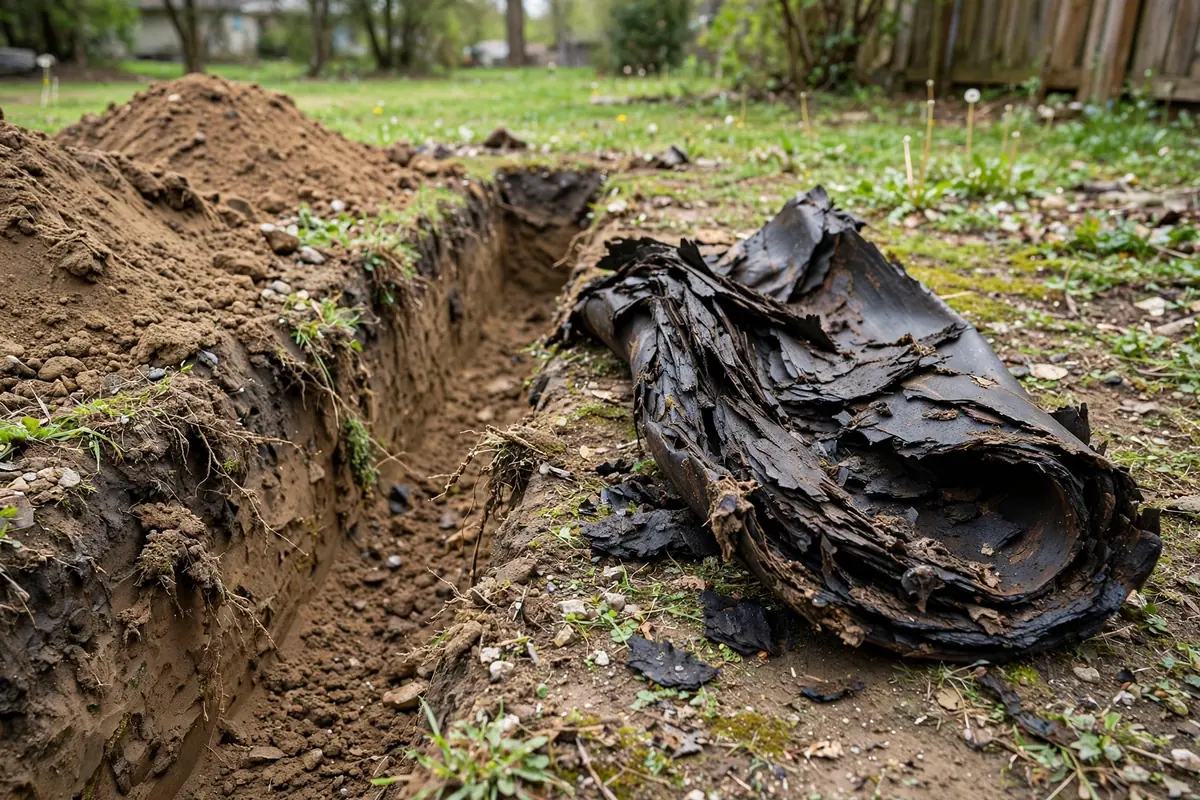
A camera survey is the reliable test. On screen the fibre wall looks blistered, flaky and often visibly oval, quite unlike the hard, even surface of clay, iron or plastic, and a short exposed section at the access point can confirm it.
Start at the sewer cleanout, where a CCTV sewer camera inspection enters the run. The operator watches for a dark, layered wall that flakes at the edges, blisters bulging into the bore and a passage that has flattened into an egg shape instead of a circle. Where the tube meets the house or the street, a small exposed piece sometimes shows the brown-black layers directly, which settles the question for a home needing sewer line repair in Altoona, PA.
The age of the house is a clue, never a proof. A home built in the decades when this material was common, with no record of a later renewal, deserves a look before problems start, and a pre-purchase sewer scope gives a buyer that look while there is still time to negotiate. Keep the sewer inspection report and footage from any survey: if the wall is fibre, that recording becomes the baseline every later decision is measured against.
Why Does It Lose Its Round Shape Over Time?
Water is the slow enemy. The pitch seal breaks down, the fibres drink in moisture, and the softened wall gives way a little more each year under the weight of soil above it, flattening from a circle toward an oval.
Orangeburg deterioration follows a steady sequence. Ground moisture reaches the wall, the pitch loses its grip, and the fibre layers swell and blister inward. Each blister narrows the bore and roughens the surface, so paper and solids catch more easily. Meanwhile the load from the ground presses on a wall that can no longer push back evenly, and the crown of the tube sinks while the sides bulge.
Once the shape starts to go, other troubles move in. Tree root intrusion finds the softened joints, and a low stretch can form where the flattened section also drops, leaving a belly that holds water between uses. Homes following guidance for sewer line repair in New York meet the same physics as anywhere else: a round tube sheds load around its curve, and a flattened one cannot, so each year of softening makes the next year harder.
Why Does Lining Rarely Work Inside A Deformed Tube?
A liner cures against the inside of the host tube and copies its shape. Inside a round tube that gives a smooth new surface; inside a flattened one it wrinkles, bridges and leaves gaps, so the finished liner inherits the very fault it was meant to fix.
Cured-in-place pipe lining (CIPP) relies on the host for its geometry. A resin-soaked tube is inflated until it presses against the old wall, then it hardens in that position. If the wall is round, the result is round. If the wall has gone oval, the liner sets oval too, with folds where the extra material bunches and thin spots where it has stretched, and flow still has to squeeze through the same flattened passage.
That is why a pro who finds fibre on camera usually changes the conversation from renewal to replacement of the Orangeburg pipe itself. A liner can still suit a neighbouring run of sound clay or iron on the same property, and the footage will show where one material ends and the other begins. What it cannot honestly do is give a softened, flattened tube back the circle it has lost, however neatly the resin cures.
Which Repairs Actually Fit A Failing Fibre Line?
Replacement, by one of two routes. A new tube can be drawn through the old run with minimal digging where conditions allow, or the run can be opened and re-laid. Cleaning and cutting can buy time, but they do not change the wall.
Pipe bursting suits many fibre runs because the old material splits apart readily as the bursting head passes, drawing a new HDPE pipe in behind it. The ground above mostly stays undisturbed, which matters where the run passes under a drive or a mature garden. A camera survey first confirms the run is straight enough, deep enough and clear of obstacles that would stop the head on its way to a house needing sewer line help in Athens, OH.
Where bursting cannot go, open-trench replacement uncovers the run and lays new PVC pipe (SDR-35 and Schedule 40) at the correct fall, and spot excavation repair can deal with a single failed point while a full job is planned. The choice turns on length, depth, access and what sits above the line. What all three routes share is that they retire the fibre wall instead of asking it to keep working.
What Happens If You Keep Patching And Clearing It?
Each clearing removes a symptom and leaves the cause. The bore narrows again as blisters grow, roots return through softened joints, and a wall that keeps flattening can fold in altogether, turning a slow drain into a full backup.
There is a place for buying time. Hydro jetting on a gentle setting, or mechanical root cutting, can restore flow while a replacement is quoted and scheduled, and for a line that still holds a near-round shape that pause can be measured in months. The risk is treating each successful clearing as proof the line has recovered. Orangeburg deterioration does not pause between visits; the wall keeps softening whether water is moving through it or not.
The end of that road is rarely tidy. A section that folds in becomes a cracked or collapsed pipe underground, soil washes into the gap, and soil erosion and voids around the pipe can leave the ground above unsupported, sometimes showing as a dip in a lawn or drive. Sewage backing up toward the foundation is the other unwelcome arrival. Planning a replacement while the line still drains, as homeowners reading about sewer line repair in Pennsylvania often do, is calmer and usually simpler than digging after a collapse.
How Do Cost And Timing Decisions Get Made After A Scope?
The survey decides, then the ground decides. Footage showing how much of the run has flattened sets the scope, and depth, access and the surface above set how disruptive each replacement route will be for that property.
Ask the pro to grade what the camera found, stretch by stretch. A run that is oval in one place and sound elsewhere raises a different plan from one flattened along its whole length, and the proper slope / grade of a sewer line must be restored either way, or the new tube will trap solids just as the old one did. A second CCTV sewer camera inspection after the work proves the new run is round, clear and falling the right way before anyone fills the ground back in.
Cost follows factors, not a flat figure: how far the run is, how deep it sits, whether it passes under concrete or planting, and how much surface has to be put back. Whether any cover responds is a separate question, explored in our guide to cover for a failing line. If your drains are slowing now, one free call connects you with an independent local pro who can typically arrive in 30–60 minutes, answered 24/7 — the right first step for a home needing sewer line repair in Abington, PA as much as anywhere else.
Frequently Asked Questions
Short answers for owners who suspect, or have just been told, that their buried line is fibre pipe. If your question is not here, call free and ask — lines are answered 24/7.
Still Have Questions? Call Free
One free call connects you with a local pro.
(800) 555-0100Free Call · Answered 24/7 · No Obligation
Reviewed By Hamza
Master Plumber & Trenchless Sewer Rehabilitation Specialist
Hamza is a licensed master plumber and underground infrastructure specialist with extensive field experience resolving sewer lateral collapses, root intrusions, and structural line offsets across Pennsylvania, Ohio, and New York. He specializes in high-definition CCTV pipe diagnostics, cured-in-place pipe (CIPP) lining, pipe bursting, and non-invasive trenchless rehabilitation to restore residential and commercial sewer systems without property destruction.
Updated October 31, 2026
Need Sewer Line Repair Near Me?
One free call connects you with an independent local pro — answered 24/7, no obligation.
Call (800) 555-0100Free Call · Answered 24/7 · Local Pros Near You