Flushable Wipes and Fatbergs: What Really Blocks a Sewer Line
Free Call · Answered 24/7 · Local Pros Near You
The Short Answer
Yes. A wipe can leave the toilet bowl and still stay in one piece far down the underground pipe, because it does not fall apart in water the way toilet paper does. Sheets pile up where the flow slows, where the wall is rough, or where the run changes direction. Over days and weeks that soft pile hardens into a plug, drains slow across the house, and sewage can push back inside. The only safe place for any wipe is the trash.
Call (800) 555-0100Do Flushable Wipes Clog Sewer Lines, Explained In Plain Words
Do Flushable Wipes Really Break Down After Flushing?
Not in the way toilet paper does. Toilet paper is made to fall apart within moments of getting wet, while a wipe is woven to stay strong when wet, so it can travel the whole run still in one sheet.
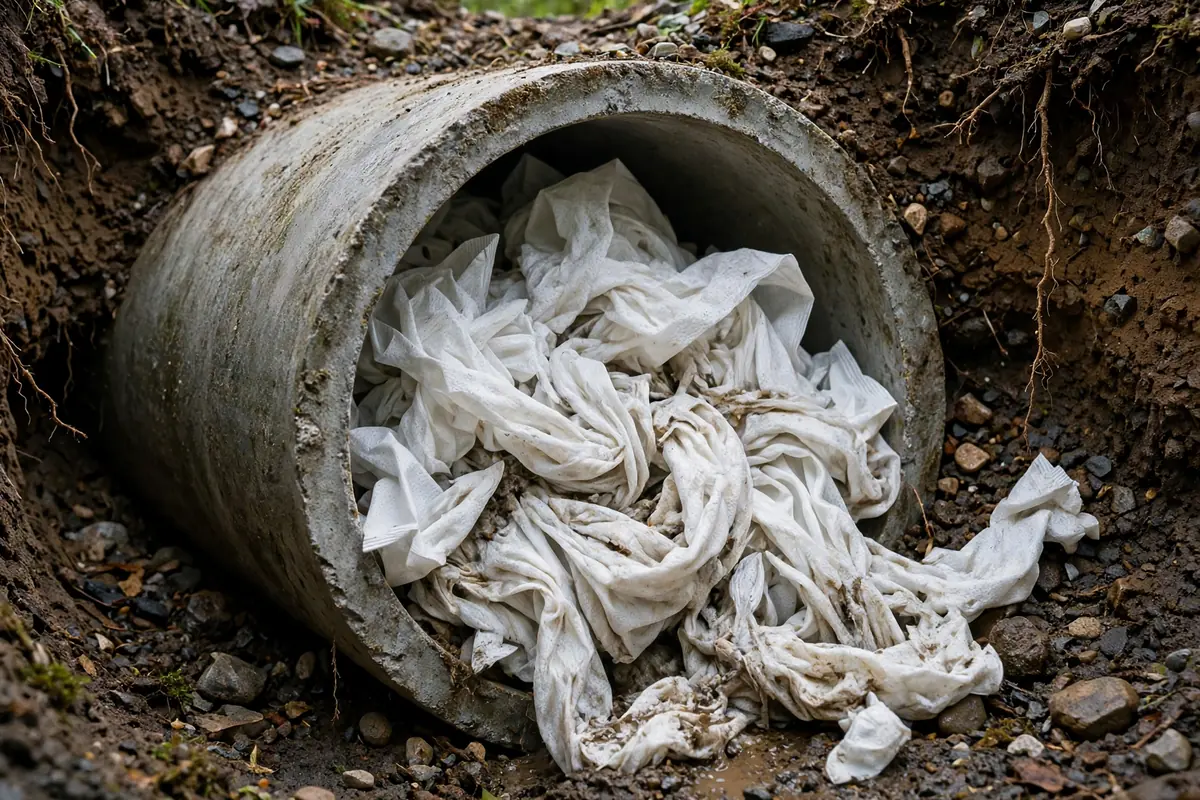
That strength is the selling point at the sink and the problem underground. A wipe has to survive scrubbing a counter, a baby or a pair of hands without tearing, so its fibres are longer and more tightly bonded than paper. Water moving through a household pipe does not pull those bonds apart quickly. By the time flow reaches the street, many sheets are still recognisable as sheets.
Think about the timing. A flush moves waste through the house plumbing in seconds, and then flow slows in the wider underground run. A sheet that needed hours to soften is now sitting in slow water while the next flush, and the next, sends more sheets after it. Nothing in that picture breaks the pile down. It only adds to it.
Packaging language adds to the confusion. Flushable on a packet usually means the item will pass through a toilet and a short stretch of pipe in a test, not that it will vanish inside an ageing line with rough walls and shallow fall. Homeowners who want the fuller picture can read our guide on how often a sewer line inspection makes sense, because a camera look shows what has been collecting long before drains stop.
Where Inside The Pipe Do Sheets Catch First?
Sheets catch where the inside of the pipe stops being smooth: at a joint that has shifted, on rough or rusted walls, on roots that have pushed through a crack, and in any low stretch where water pools instead of running clear.
An offset joint is the classic snag point. Two lengths that no longer line up leave a small lip, and a flexible sheet drapes over that lip and stays there. The next sheets wrap around the first, and paper and waste wrap around them. What began as one wipe becomes a net stretched across the bore.
Material matters just as much. A vitrified clay pipe has a joint every few feet, and each joint is a chance for a sheet to catch or for roots to enter. A cast iron pipe that has rusted inside offers a wall like sandpaper, so sheets drag, slow and stick instead of sliding. Newer smooth plastic runs shed sheets far more easily, which is why the same flushing habit can trouble one house and not the next.
Tree root intrusion turns a snag into a trap. Fine roots enter through a cracked joint, spread into a feathery mass, and strain the flow like a sieve. Wipes are often the first bulky item that mass catches, and once they mat into the roots the opening narrows fast. That pattern shows up often in older streets, including homes booking sewer line repair in Auburn, NY, where mature trees and older clay runs sit side by side.
How Does A Loose Pile Harden Into A Solid Plug?
A fatberg forms when trapped sheets soak up kitchen fat that has cooled and hardened on the pipe wall. The sheets give the fat a frame to build on, and the combined mass sets firm, narrowing the pipe a layer at a time.
Fat poured or rinsed from pans does not stay liquid underground. It cools, coats the wall, and turns waxy. A mat of wipes pressed against that coating picks the fat up, holds it in place, and gives the next wash of greasy water something rough to stick to. Week by week the deposit thickens inward from the wall and outward from the mat at the same time.
The U.S. Environmental Protection Agency (EPA) discusses these combined blockages in its wastewater guidance, because the same mix blocks town systems as well as household runs. At home the scale is smaller, but the chemistry is identical: fibre plus cooled fat plus time equals a mass that water alone will not shift.
Our companion post on kitchen fat coating a household line covers the other half of this in detail. Read together, the two habits explain each other. Stop either one and the mass grows far more slowly; stop both and the pipe mostly carries water, paper and waste, which is all it was built to carry.
What Early Signs Suggest Wipes Are Collecting?
Watch for drains that gurgle after a flush, a toilet that rises higher than usual before it empties, slow drainage in more than one room, and smells near the lowest drain in the house. One room alone usually points to a local trap; several rooms point underground.
The pattern is gradual, then sudden. For a while the line still passes water around the growing mat, so the only clue is slowness on heavy days, when laundry, showers and flushing overlap. Then a guest visit or a big wash adds the sheet that closes the gap, and the lowest openings in the house show the problem first.
A floor drain in the basement is often that first opening. Water appearing around it after someone showers upstairs means the underground run could not take the flow away fast enough. Sewage smells coming and going, rather than staying constant, fit the same picture, because gas escapes around a partial blockage in bursts.
Homes arranging sewer line repair in Akron, OH often describe exactly this slow build before a full backup. Acting at the gurgle stage matters. A partial mat can usually be cleared and checked in one visit, while a settled mass that has backed sewage into the house adds cleaning, damage and a much longer day.
What Else Should Never Go Down A Toilet Or Drain?
Only toilet paper and human waste belong in a toilet. Paper towels, tissues, cotton buds, dental floss, nappy liners, sanitary products, cat litter and cooking fat all stay whole or swell in water, and each one can start or feed a blockage.
Paper towels and tissues look like toilet paper but are made to hold together when wet, so underground they behave like thin wipes. Dental floss is worse in one way: it wraps around other material and ties a loose pile into a knot. Cotton products swell as they soak, narrowing a pipe that may already be partly lined with deposits.
The kitchen has its own list. Coffee grounds do not dissolve, egg shells add grit that settles in low spots, and leftover food scraped into the sink adds bulk that a partial blockage will catch. None of these items needs a drain. A bin beside the sink and a container for used cooking fat handle almost all of them.
House rules work better than reminders after the fact. Put a small lidded bin in every bathroom, keep wipes themselves out of the house if guests keep flushing them, and tell visiting family plainly that the pipes are old.
How Does A Pro Clear And Check A Wipe Blockage?
A pro clears the mass, then looks inside the pipe to see why it formed there. Clearing alone is not the finish, because a snag point left in place will collect the next sheets in the same spot.
Access usually comes through the sewer cleanout, the capped opening that lets tools reach the underground run without digging. From there, hydro jetting can scour a mat of sheets and greasy coating off the wall with high-pressure water, washing the loosened material onward to the public sewer main. In a line narrowed by roots, mechanical root cutting may be needed first to reopen the bore.
After clearing, a CCTV sewer camera inspection travels the run and shows what the water hid: the lip, the roots, the rust, or a belly / sag in the line where water pools and sheets settle. The sewer inspection report and footage from that run is your record of where the problem sits and how much of the pipe it affects, and it guides any repair choice that follows.
Where the camera finds a cracked or collapsed pipe, clearing is only a pause, and the conversation turns to repair options for that section. Where it finds only a snag from pipe corrosion and scaling, a cleaning plan and new flushing habits may be enough. Homeowners in Allentown, PA, booking sewer line repair hear the same order of work: clear, look, then decide, never decide blind.
How Do You Keep Wipes Out Of The Line For Good?
Make the bin easier than the flush. A lidded bin in each bathroom, wipes kept for cleaning rather than personal use where possible, and a quick word with everyone in the house will prevent most repeat blockages.
Habits beat hardware here, but one fitting knowledge helps. Knowing where your sewer cleanout is, and keeping it reachable, means a pro can start clearing at once if a blockage still happens. Knowing the age and material of your underground run helps too, because an old clay line deserves stricter rules than a new smooth one. The background on sewer line repair in Pennsylvania and on sewer line repair in New York shows how much local pipe age varies street by street.
Keep the proper slope / grade of a sewer line in mind when any yard work happens. Heavy loads driven over a shallow run, or soil settling after other digging, can flatten the fall and create the low spot where sheets settle. If drains slow again after any ground work, that change in fall is worth checking before assuming habits slipped.
If drains are already slow in several rooms, or sewage has appeared indoors, do not keep flushing to test it. Stop adding water, keep people and pets away from any spill, and call. One free call connects you with an independent local pro, a pro can typically arrive in 30–60 minutes, and lines are answered 24/7, so the next step can start the same day. For a smaller town picture, homeowners near Altoona, PA, sewer line repair use the same call-first route.
Frequently Asked Questions
Short answers about wipes, snags and blockages in household pipes. If drains are already backing up, call free — lines are answered 24/7.
Still Have Questions? Call Free
One free call connects you with a local pro.
(800) 555-0100Free Call · Answered 24/7 · No Obligation
Reviewed By Hamza
Master Plumber & Trenchless Sewer Rehabilitation Specialist
Hamza is a licensed master plumber and underground infrastructure specialist with extensive field experience resolving sewer lateral collapses, root intrusions, and structural line offsets across Pennsylvania, Ohio, and New York. He specializes in high-definition CCTV pipe diagnostics, cured-in-place pipe (CIPP) lining, pipe bursting, and non-invasive trenchless rehabilitation to restore residential and commercial sewer systems without property destruction.
Updated October 31, 2026
Need Sewer Line Repair Near Me?
One free call connects you with an independent local pro — answered 24/7, no obligation.
Call (800) 555-0100Free Call · Answered 24/7 · Local Pros Near You