HDPE and Pipe Bursting: The New Pipe Pulled Through the Old One
Free Call · Answered 24/7 · Local Pros Near You
The Short Answer
The polyethylene pipe used for this trenchless replacement is chosen because it is flexible, fused into one continuous length, and smooth inside, so it can be pulled through a broken old line in a single run. A splitting head breaks the old pipe apart as the new one follows behind it, so most yards need only small entry and exit pits instead of a full trench. Where the old line still sits at a workable fall, the new pipe can even be one size larger.
Call (800) 555-0100Hdpe Pipe Bursting Sewer, Explained In Plain Words
Why Is HDPE Used For Bursting?
The HDPE is chosen because the material bends without cracking, its sections fuse into one continuous length with no separate joints, and its inner wall stays smooth. A pipe that must travel underground through a broken line needs all three qualities at once.
The lines it replaces were rarely built for this. A vitrified clay pipe is rigid and jointed every few feet, a cast iron pipe is strong but rough inside once corrosion starts, and an Orangeburg pipe can soften and lose its round shape. None of those can be pulled, bent or stretched. The polyethylene replacement can flex along the path the old line took, within limits, and arrive in one piece rather than as a chain of short sections pushed together.
The fused joints matter as much as the flexibility. Every joint in an older line is a weak point where roots push in and groundwater leaks through. A fused length has no such gaps along the run, which is one reason tree root intrusion is far less likely to return through the new wall. The smooth bore also lets water and waste move without catching on rough scale or raised joint edges, so the line starts its life flowing freely.
How Does The Pull-Through Method Work?
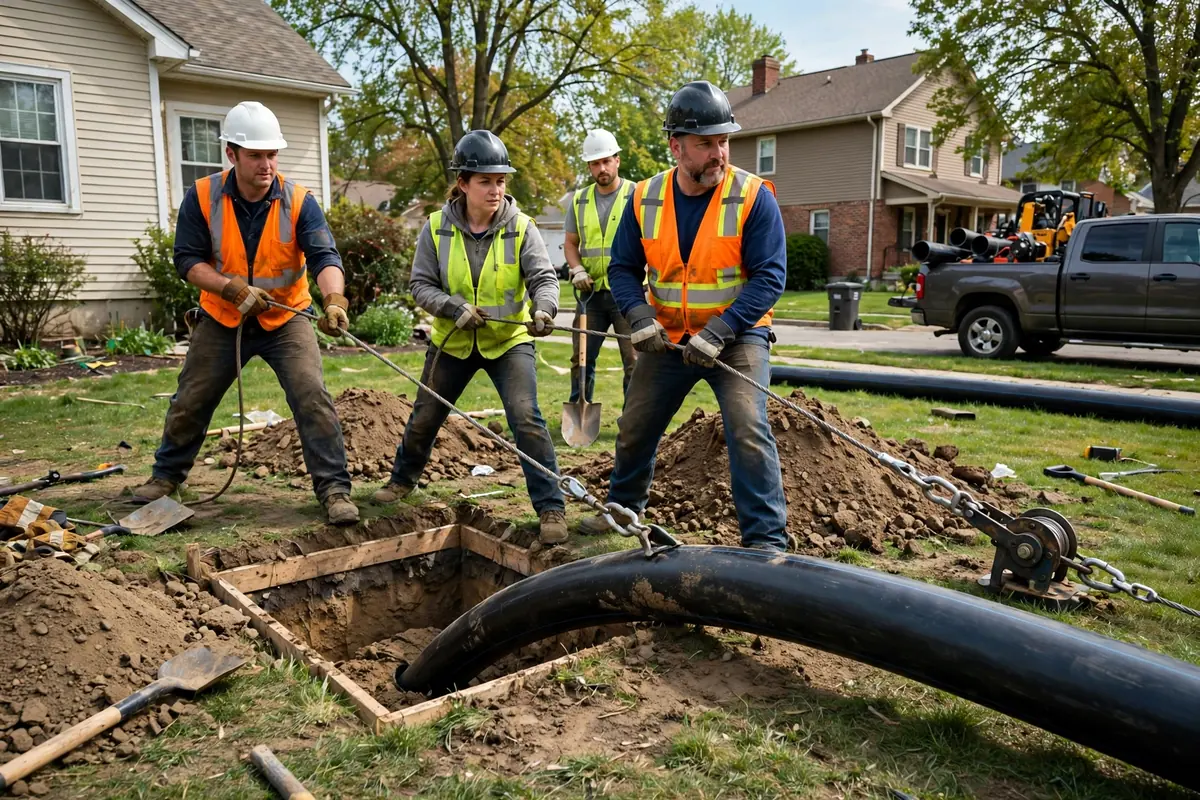
Crews dig a small pit at each end of the failing run instead of opening the whole yard. A cable or rod passes through the old pipe first, a splitting head follows it, and the new pipe is pulled in directly behind the head.
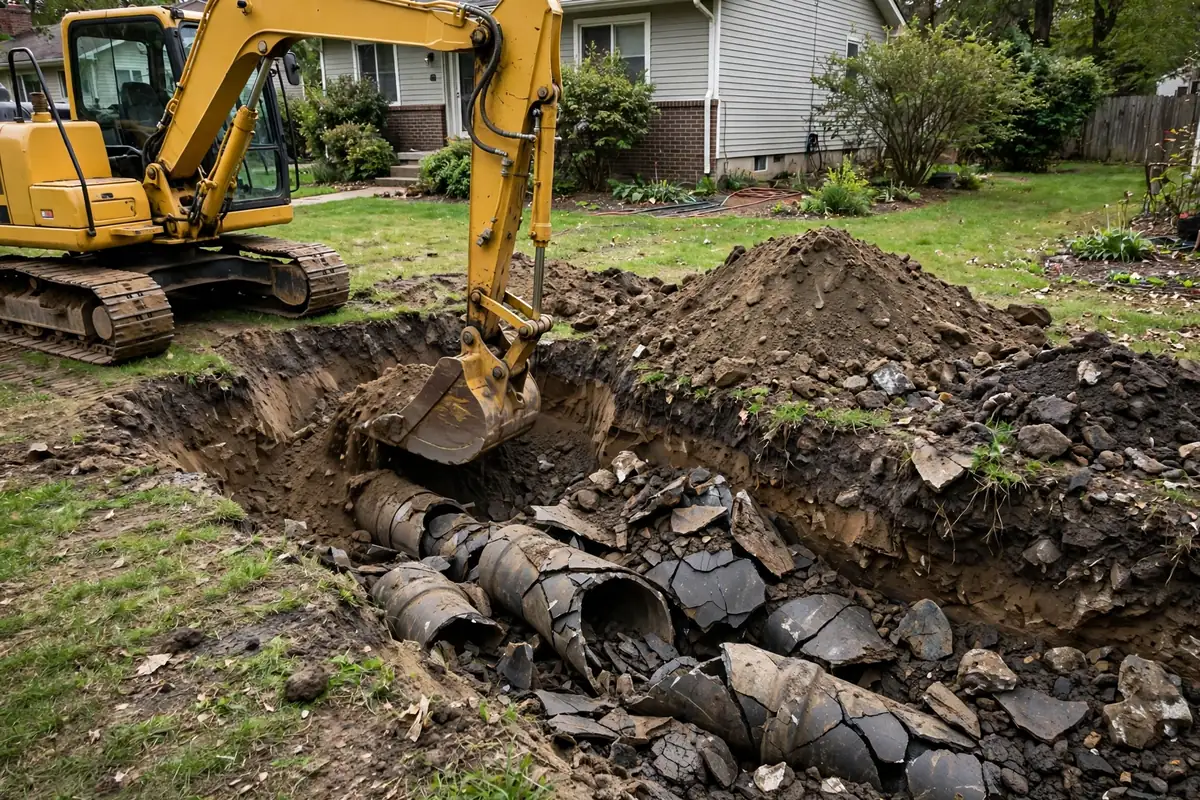
The run usually starts at a pit near the house and ends where the sewer lateral meets the public sewer main. As the head advances it splits the old clay, iron or fibre pipe and presses the fragments outward into the surrounding soil, clearing a tunnel at or slightly above the old pipe's size. Nothing of the old line is hauled away, because it stays in the ground as broken pieces around the new pipe.
Once the new length is through, the crew reconnects both ends. At the house end the joint is made with a Fernco coupling sized to the pipes being joined, and at the street end the connection is checked against the main before the pits are filled. Homeowners reading about sewer line repair in Auburn, NY often ask why two pits still count as trenchless: the digging is limited to those pits, while the ground above the run itself stays closed.
When Does This Method Suit A Failing Line, And When Does It Not?
It suits a line that is broken, root-filled or worn out but still follows a usable path and fall. It cannot fix a line whose route itself is the problem, because the new pipe follows the old route closely from pit to pit.
A cracked or collapsed pipe that still holds a passable channel is the classic candidate, and an offset joint can often be split through and replaced by the new continuous run on the same pass. Soil matters too. In expansive / clay-heavy soil, where ground movement works separate joints apart over time, a joint-free length removes many of the points that movement used to attack first.
The limit is shape and fall. Where the old line has a belly / sag in the line, the replacement tends to inherit that low spot, because it travels the same path at the same depth. Standing water would collect in the new pipe just as it did in the old one. That is why our guide to sewer line slope problems matters here: a line with the wrong fall may need excavation and re-grading instead. Crews serving sewer line repair in Akron, OH check the fall on camera before they recommend any pull-through job.
How Does It Compare With Lining And With Open Digging?
Lining keeps the old pipe as a shell and builds a new wall inside it. The pull-through method removes the old pipe's role entirely and installs a full new pipe. Open digging also installs a new pipe, but with the whole route exposed.
Cured-in-place pipe lining (CIPP) suits a host that is cracked but still round and holding its line. The pull-through method instead breaks the host out of the way, which also allows a modest size increase where the ground allows it. Where neither approach works — a host that has lost its shape and direction entirely — open-trench replacement gives the crew full sight of the bed the pipe sits on and the fall along the whole run.
An open dig usually installs PVC pipe, which is rigid, jointed and laid in sections on a prepared bed — a sound method, but one that opens the whole route from house to street. The pulled plastic length needs no prepared bed along the run, because it arrives supported by the ground the old pipe already occupied. Homeowners comparing options for sewer line repair in Altoona, PA are often choosing between yard disruption now and easy access later, not between a good pipe and a bad one.
What Must Happen Before Any Pulling Starts?
The line is scoped, located and cleared for digging first. Nobody pulls a new pipe through a line they have not seen, because the camera findings decide whether the method fits at all.
A CCTV sewer camera inspection shows the breaks, roots and low spots, and proves the old pipe still offers a path the head can follow. The crew enters through the sewer cleanout where one exists, and a sonde locator at the camera head lets them mark the line's route and depth on the surface above. Those findings go into the sewer inspection report and footage you keep with your house papers.
Before the pits are dug, the other buried services along the route must be marked: Call 811 before any digging, every time, because even small pits still reach buried lines. Where the run crosses a right-of-way / easement near the street, the town may also set conditions on the pit at that end. State context helps here too: our page on sewer line repair in New York explains how the street-end connection is treated across the state.
What Does The Cost Of A Pull-Through Replacement Depend On?
The quote turns on the run itself: its length, its depth, the ground it passes through, and what sits above it. Two homes on the same street can get different figures for honest reasons.
Length and depth come first, because they set the size of the job and the pits at each end. While the old line is out of service, bypass pumping may be needed to keep the home draining, and deeper pits can call for trench shoring to hold their sides safely. The connection work near the foundation also adds time, especially where the old pipe leaves the house at an awkward angle or depth.
What sits above the pits finishes the picture: a driveway edge, a path, planting or a porch step all have to be lifted and put back or worked around. Whether the job can stay a pull-through at all also shapes the figure, since a section that needs opening by hand changes the plan. Homeowners pricing sewer line repair in Allentown, PA sometimes ask whether cover they hold changes the bill; our guide to sewer line insurance coverage explains which add-ons may respond to a failed line.
What Should You Check After The New Pipe Is In?
Ask for a final camera pass before the pits are closed for good. The new line should be proven on screen, not assumed, and the footage from that pass is the record that proves it.
The pass should show a clean, continuous bore, connections seated at both ends, and water running freely toward the street at the proper slope the route allows. If any stretch still ponds on screen, raise it while the pits are still open, because correcting it later means digging again. Keep the footage, the invoice and any permit or inspection notes together, so a future buyer or insurer can see exactly what was installed and when.
Homes covered by sewer line repair across Ohio follow the same routine: prove the line, keep the records, then fill the pits. If your line is showing early signs — slow drains, gurgling sounds, sewage smells in the yard — do not wait for a full blockage. One free call connects you with an independent local pro, lines are answered 24/7, and a pro can typically arrive in 30–60 minutes to scope the line before you choose any method.
Frequently Asked Questions
Short answers to the questions people ask most about this replacement method. If your question is not here, call free and ask — lines are answered 24/7.
Still Have Questions? Call Free
One free call connects you with a local pro.
(800) 555-0100Free Call · Answered 24/7 · No Obligation
Reviewed By Hamza
Master Plumber & Trenchless Sewer Rehabilitation Specialist
Hamza is a licensed master plumber and underground infrastructure specialist with extensive field experience resolving sewer lateral collapses, root intrusions, and structural line offsets across Pennsylvania, Ohio, and New York. He specializes in high-definition CCTV pipe diagnostics, cured-in-place pipe (CIPP) lining, pipe bursting, and non-invasive trenchless rehabilitation to restore residential and commercial sewer systems without property destruction.
Updated October 31, 2026
Need Sewer Line Repair Near Me?
One free call connects you with an independent local pro — answered 24/7, no obligation.
Call (800) 555-0100Free Call · Answered 24/7 · Local Pros Near You