Was Your Sewer Line Installed Wrong? Slope, Bedding and Early Failure
Free Call · Answered 24/7 · Local Pros Near You
The Short Answer
Yes. A line laid too flat lets solids settle and clog, and a line laid too steep can let water rush ahead of the solids, and both mistakes can make a newer pipe fail years early. Poor bedding makes it worse: soil that was not packed firmly under the pipe settles over time, the line dips, and standing water collects in the dip. The repeat clogs that follow look like wear, but the cause was built in on installation day.
Call (800) 555-0100Sewer Line Slope Problems, Explained In Plain Words
Can A Sewer Line Be Installed With The Wrong Slope And Fail Early?
Yes — the fall of the line is set on the one day the trench is open, and if it is wrong then, the line carries the fault for life. Unlike a worn-out pipe, an installation fault is present from the very first flush.
The sewer lateral leaves your home and must fall steadily all the way to the street. That steady fall, the proper slope, is what carries solids along with the water instead of leaving them behind. Lay the run too flat and solids drop out of the flow and build up on the pipe floor. Lay it too steep and the water can outrun the solids, stranding them on the wall to harden layer by layer.
Because the fault is built in, the trouble starts young. A line can be only a few seasons old and already clogging on a predictable schedule, while a correctly laid line of the same age gives no trouble at all. Homeowners arranging sewer line repair in Auburn, NY run into exactly this pattern: the pipe itself turns out to be sound, unbroken and unrotted, and the fall is the fault.
Fall is only half of an installation, though. The ground packed beneath the pipe decides whether the fall set on day one is still there years later, and that bedding question gets its own section below.
What Does The Fall Of The Line Actually Control?
It controls whether waste travels or settles. At the proper slope, water moves at a pace that carries solids along with it, scouring the pipe floor lightly as it goes and arriving at the street with its load still moving.
Think of the flow as a slow conveyor. Moving water keeps paper and solids suspended and pushes them forward in pulses each time a toilet flushes or a tub drains. That carrying action continues the whole way down the run until the flow reaches the public sewer main. Where the fall flattens out, the conveyor slows, the load drops, and each day adds a little more settled material at the same low stretch.
A too-flat stretch also holds water between uses, and standing water changes what happens inside the pipe. Grease that arrives warm and liquid cools in that still water and sticks, so grease buildup forms fastest exactly where the fall is weakest. Homeowners reading about sewer line repair in Akron, OH often describe the cycle this creates: the line is cleaned, flows well for a while, then clogs again at the same place because the fall never changed.
How Does Poor Bedding Under The Pipe Cause Damage?
The pipe rests on its bedding along its whole length, and that bedding is its support. Where the bedding was loose, thin or full of stones and gaps, the ground under the pipe settles unevenly — and the pipe follows the ground down.
Rainwater moving through loose soil washes the fine material away first, which is how soil erosion and voids around the pipe begin under a line that looked solid when it was buried. A section left spanning a hollow like that carries weight it was never meant to carry alone. Expansive / clay-heavy soil makes the cycle worse, swelling when wet and shrinking when dry, so a badly bedded pipe is worked up and down with the seasons instead of resting still.
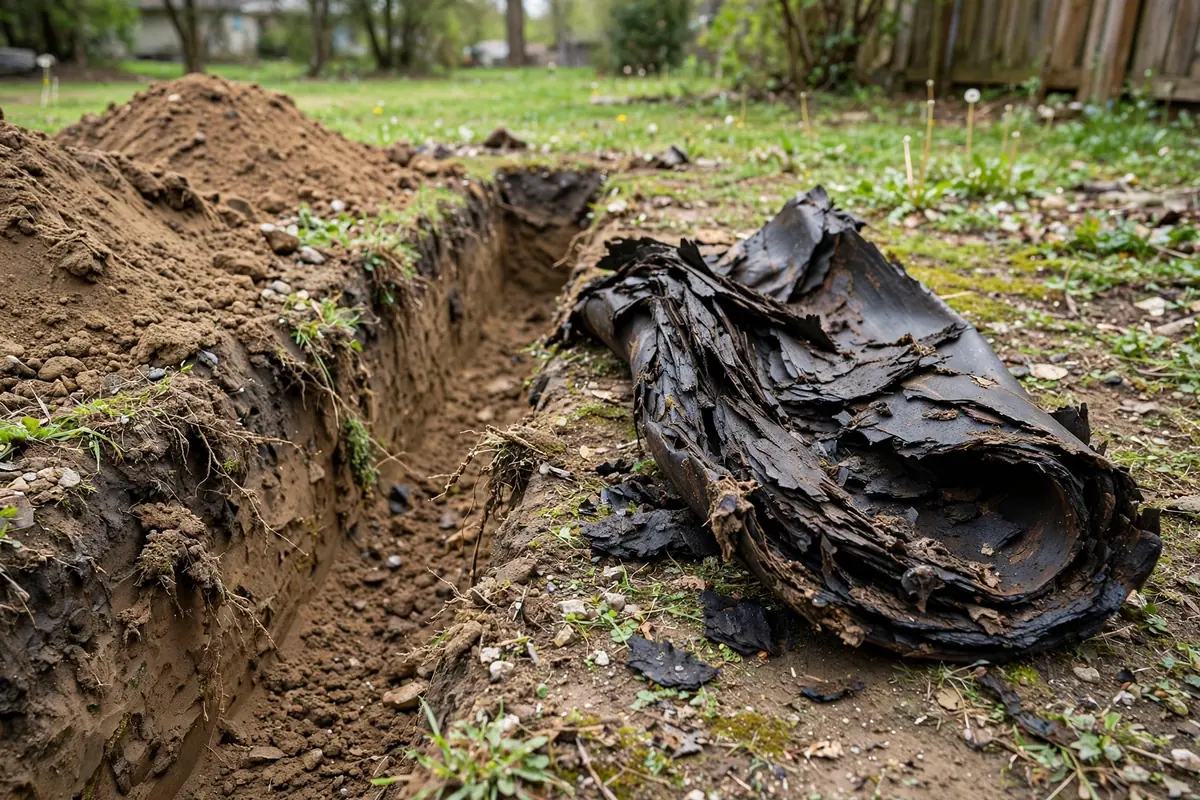
Over years that movement shows up as real damage. Each freeze-thaw cycle can shift a poorly supported joint a little further, until the joint opens into an offset joint that catches paper and lets roots in. Tree root intrusion follows the moisture at that gap, and infiltration — groundwater leaking in through the same opening — adds flow the line was never sized for. Left long enough, a spanning section can end as a cracked or collapsed pipe. State background on sewer line repair in New York covers how soil and winter movement affect buried lines across the state.
What Signs Suggest The Line Was Installed Wrong, Not Just Worn Out?
The pattern, not the age of the house. A line that clogs at the same spot on a repeating cycle, in a home too new for its pipes to be worn out, is pointing at how it was laid rather than how long it has served.
Repeat trouble at one fixed point is the strongest clue. Cleaning clears it, the drains run well, and then the same blockage rebuilds in the same place because the cause — a stretch that holds water — is still there. When a camera later finds standing water sitting in a belly in the run, that low section is the story. Backups that show first at the sewer cleanout, the access point in the yard or basement, also fit a line that cannot move its load along properly.
Age and material sharpen the picture. A newer home drained by a PVC pipe run should not be clogging regularly at all, so a fault in the laying is the likely explanation. Older homes are different: a vitrified clay pipe or cast iron pipe line has had decades to corrode, shift and fill with roots, and wear explains its failures honestly. Homeowners checking sewer line repair in Altoona, PA with an older house should expect the camera to separate those two stories before anyone talks about digging.
How Does A Camera Inspection Prove A Slope Problem?
The camera shows what the eye cannot: standing water where the pipe should be empty, and exactly how far along the run it sits. That picture, with distances, is the difference between suspecting a fall problem and proving one.
A CCTV sewer camera inspection travels the full run and records it. On a correctly laid line the pipe drains dry between uses; on a badly laid one the camera dips under standing water at the low stretch and comes up again after it. The crew pairs the camera with a sonde locator, a small transmitter at the camera head, so the low stretch can be marked on the surface with its depth. All of it is kept in the sewer inspection report and footage, which shows any later pro — or an insurer — exactly where the fault sits.
The same survey rules other causes in or out. Roots, cracks and grease each look different on screen from a simple low stretch, so the repair can target the real fault instead of guessing. Where smells or leaks point somewhere the camera cannot explain, our guide to sewer smoke testing covers the test that traces those paths. Crews working around sewer line repair in Amsterdam, NY use that combination — prove it on camera, mark it on the surface, then decide.
Can A Line With The Wrong Fall Be Corrected?
A short bad section can often be opened, re-bedded and re-laid on its own. A whole run laid at the wrong fall has to be re-laid, because methods that work inside the old pipe simply copy the shape they find.
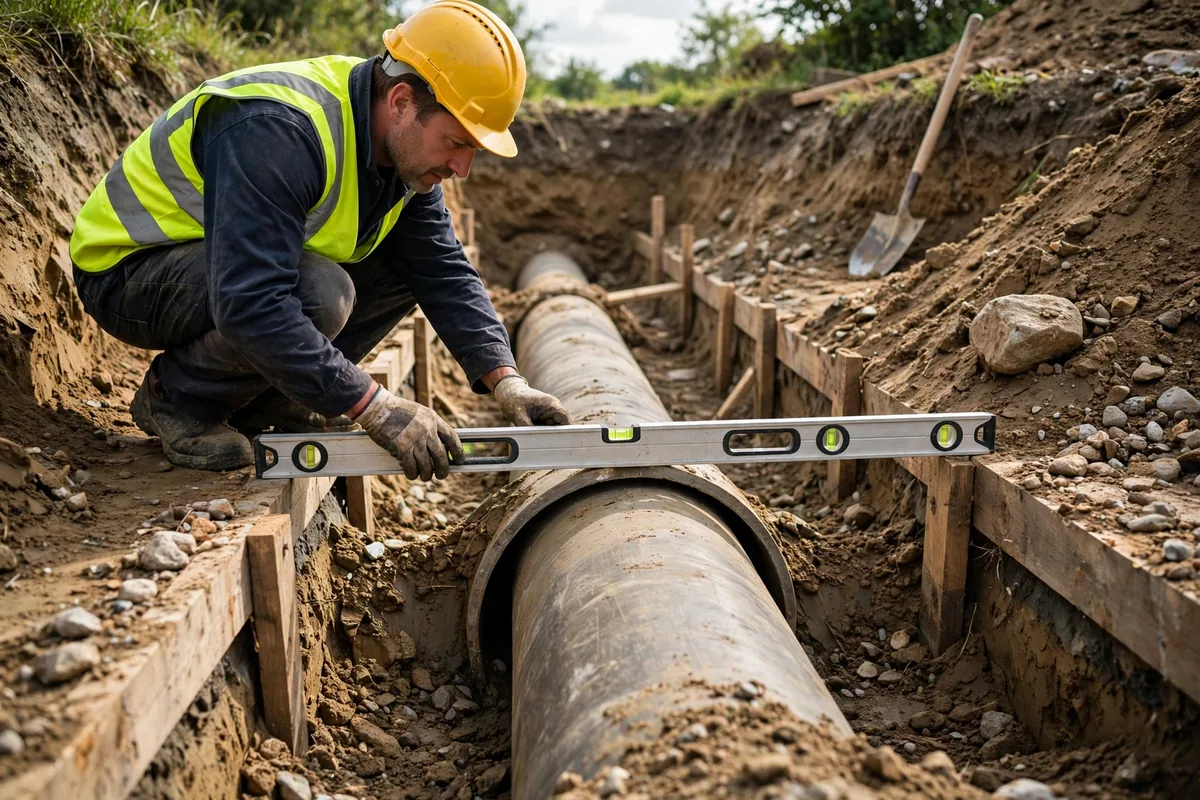
Where the camera marks one settled stretch, a spot excavation repair opens just that section: the pipe is lifted or replaced, fresh bedding is packed beneath it at the right fall, and the trench is closed. Where the fall is wrong along most of the run, open-trench replacement is the honest fix, because the crew can set every section on a checked bed from house to street and prove the fall before filling anything in.
Methods that renew a line from inside cannot correct fall. Cured-in-place pipe lining (CIPP) follows the old line's shape, so a low stretch stays low under its new wall. Pipe bursting follows the old route too, even though the HDPE pipe it pulls in is new and joint-free; our guide to how the new pipe is pulled through the old one explains where that method does and does not fit. Choosing between them starts with the camera findings, not with a preference for one method.
What Affects The Cost Of Correcting A Badly Installed Line?
The figure turns on how much of the run is wrong, how deep it sits, and what has to be opened to reach it — factors, again, not a flat rate. A short settled stretch and a whole mis-laid run are very different jobs.
Length of the bad section comes first, then depth, because deeper digging is slower and the trench sides need more care. Before any of it starts, Call 811 so the other buried services in the dig area are marked. The stretch nearest the foundation usually costs the most time, since it is dug carefully by hand around the point where the pipe leaves the house, and any work under a driveway, path or porch adds lifting and making good on top of the pipe work itself.
What the surface needs afterwards finishes the picture: soil and grass are simple, concrete and paving are not. Whether the correction is one opened section or a full re-lay is the largest single factor of all. Our page on sewer line repair in Pennsylvania sets out how jobs like this are handled across the state, and a written quote should always follow a camera survey that shows the fault, never precede it.
What Should New Owners And Buyers Check Before Trouble Starts?
Ask for the fall to be checked, not just the pipe's condition. A scope that reports cracks and roots but says nothing about standing water misses the fault that causes the most repeat trouble.
A pre-purchase sewer scope is the moment to catch an installation fault, while the finding can still shape the sale. Ask the pro to say plainly whether the line drains dry, whether any stretch holds water, and whether the run keeps the proper slope from house to street. If a fault is found, our guide to sewer line insurance coverage explains which policy add-ons, if any, speak to a failed buried line and which do not.
If your drains already clog on a repeating cycle, treat that pattern as information, not bad luck. One free call connects you with an independent local pro who can typically arrive in 30–60 minutes, lines are answered 24/7, and a camera survey will show whether you are dealing with a cleaning problem or a line that was laid wrong from the start.
Frequently Asked Questions
Short answers to the questions people ask most about badly laid lines and early failure. If your question is not here, call free and ask — lines are answered 24/7.
Still Have Questions? Call Free
One free call connects you with a local pro.
(800) 555-0100Free Call · Answered 24/7 · No Obligation
Reviewed By Hamza
Master Plumber & Trenchless Sewer Rehabilitation Specialist
Hamza is a licensed master plumber and underground infrastructure specialist with extensive field experience resolving sewer lateral collapses, root intrusions, and structural line offsets across Pennsylvania, Ohio, and New York. He specializes in high-definition CCTV pipe diagnostics, cured-in-place pipe (CIPP) lining, pipe bursting, and non-invasive trenchless rehabilitation to restore residential and commercial sewer systems without property destruction.
Updated October 31, 2026
Need Sewer Line Repair Near Me?
One free call connects you with an independent local pro — answered 24/7, no obligation.
Call (800) 555-0100Free Call · Answered 24/7 · Local Pros Near You