Stopping Tree Roots Coming Back: Barriers, Planting Distance and Scheduled Cutting
Free Call · Answered 24/7 · Local Pros Near You
The Short Answer
Cutting roots out of a line clears the blockage, but it does not close the tiny opening the roots grew through, so they usually come back. Lasting prevention works on three fronts at once: slow regrowth near the pipe, keep new trees far enough away from the run, and book repeat cutting on a schedule before drains slow down again. A camera look inside the line shows where roots are getting in and which of those three fixes fits your yard.
Call (800) 555-0100How To Prevent Tree Roots In Sewer Line, Explained In Plain Words
Why Do Roots Keep Coming Back After The Line Is Cleared?
Because clearing removes the growth inside the pipe but leaves the cracked joint or small gap it entered through, and fine feeder roots quickly grow back toward the moisture and nutrients seeping out there.
That pattern has a plain name: tree root intrusion. Roots do not break into a sound pipe. They find an opening that is already there, push hair-thin tips through it, and then thicken year after year once they reach the water and food flowing inside. The thicker they get, the more they catch paper and waste, until drains slow and eventually back up.
Older lines give roots the most chances. A vitrified clay pipe was laid in short sections, so it has a joint every few feet, and each joint is a possible entry point once the seal ages. Joints in a cast iron pipe can also open a little as the ground shifts over the years. Homeowners arranging sewer line repair in Abington, PA often learn the age of the line and the number of joints explain the repeat problem better than the size of the tree does.
An offset joint makes things worse. Where one section sits slightly higher or lower than the next, the lip catches solids and the gap at the joint leaks steadily, which is exactly the damp spot roots hunt for. That is why a line can be cleared in spring and struggle again by autumn: the opening never changed, only the growth inside it was removed.
What Does A Root Barrier Do, And Where Does It Go?
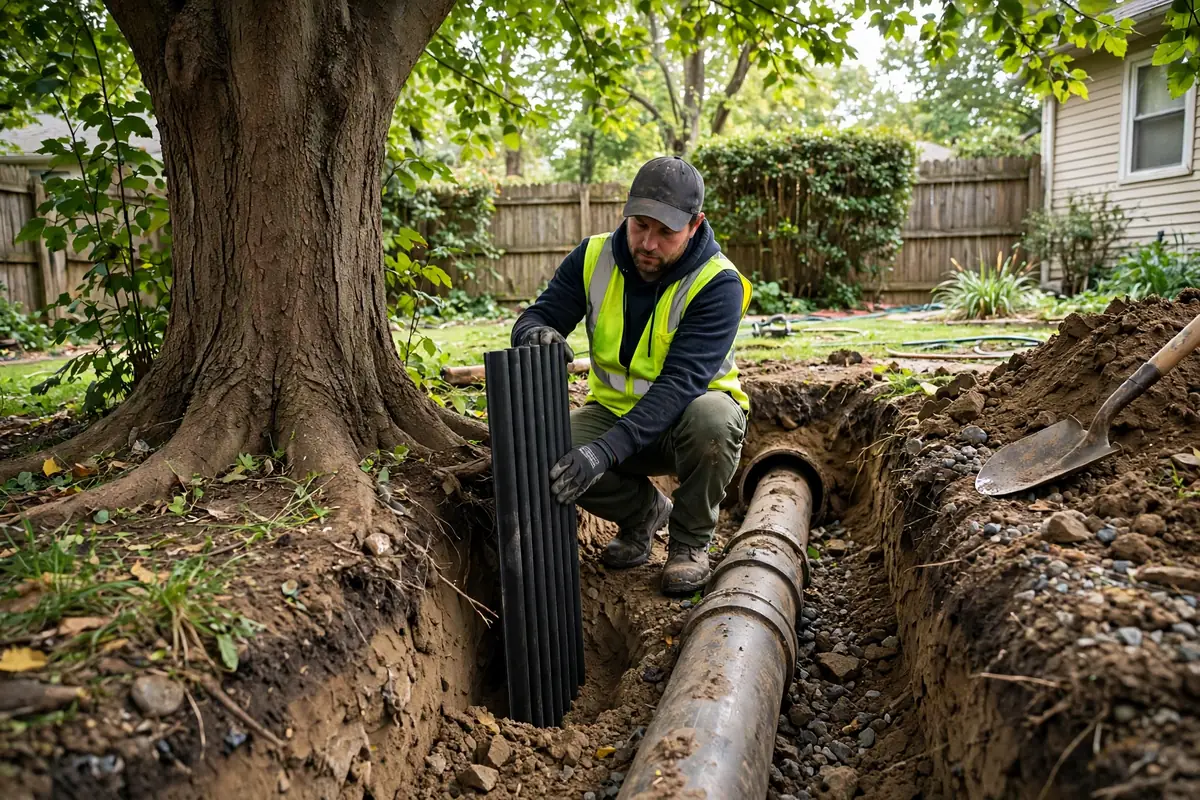
A root barrier is a panel or treated fabric placed in the ground between the tree and the line. It turns new growth downward or away, so roots pass under or around the protected stretch instead of reaching the pipe.
There are two common kinds. Solid panels made of thick plastic or metal simply block and deflect growth. Copper-treated fabric works differently: roots that touch it stop extending at the tip, so they branch elsewhere instead of pushing through. In both cases the root barrier has to run deep enough to cover the pipe and long enough to cover the stretch of line nearest the tree, or growth will just travel around the ends.
Placement matters as much as the product. Fitted close to the tree, it shapes the whole root zone but needs a wide run. Fitted close to the line, it guards that one stretch but leaves the rest of the run open. A barrier also needs care near the home itself, because digging a trench for one runs close to the foundation and to other buried services, which is work to plan, not rush.
Be clear about the limit: a barrier slows future growth, it does not seal a joint that roots already use. If growth is already inside the pipe, that entry point still needs cutting out and, in time, sealing or replacing. Guidance on planting and wastewater in the ground sits alongside sewer line repair across Pennsylvania, where large street trees and older housing often sit side by side.
How Far From The Underground Line Should New Trees Be Planted?
As a working rule, plant a new tree at least as far from the run as the tree will spread when fully grown. The wider and thirstier the mature tree, the more distance it needs.
Fast-growing, water-hungry trees are the hardest on buried lines. Willows, poplars and silver maples send out wide, searching root systems, while slower, smaller ornamental trees stay far more compact. Choosing the species is itself prevention: the right small tree in the right place rarely troubles a pipe, while a large thirsty one planted over the run is a problem booked for later.
Before planting anything, find out where the run actually goes. It rarely follows the route people guess. The line usually leaves the home at the lowest plumbing wall and runs fairly straight toward the street, passing the sewer cleanout in the yard. Mark that route on the ground first, then judge distances from the real line, not from the house wall. Call 811 before any digging so other buried utilities are marked too.
Existing big trees are a different question, because their roots are already established. Streets lined with mature shade trees are common in older areas covered by sewer line repair in Albany, NY, and there the answer is rarely to remove a healthy tree. It is to manage the line: know where growth enters, keep it cut back on a schedule, and seal the entry joints when cutting stops being enough.
How Often Should Cutting Be Booked Before Roots Block The Line Again?
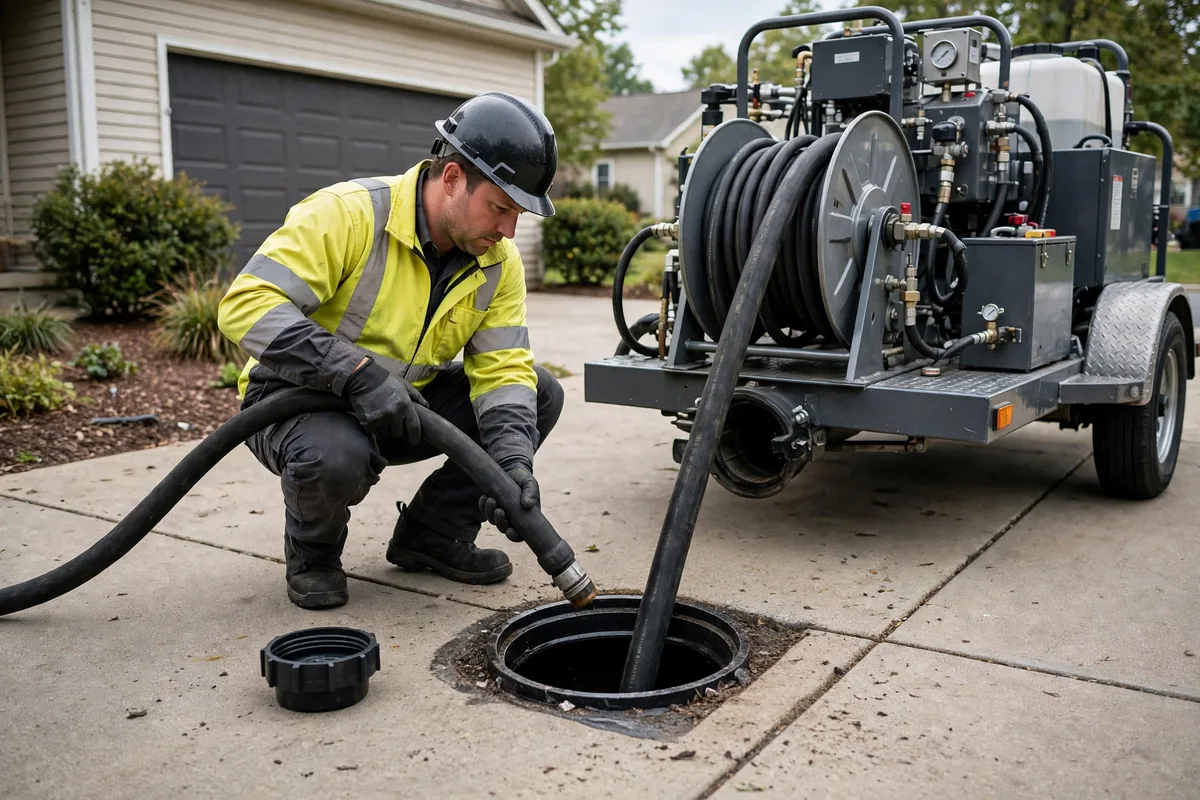
On a repeating schedule set by how fast growth returns on camera, not by waiting for the next backup. Mechanical root cutting clears the line, and the footage afterwards shows how quickly your line refills.
Mechanical root cutting uses a rotating head that trims growth back to the pipe wall and restores the full opening. It is the standard way to clear a root-filled line, and done well it leaves the inside smooth enough that waste stops catching. What it cannot do is change the joint the roots came through, which is why the booking has to repeat.
The honest way to set the gap between visits is evidence. A CCTV sewer camera inspection after cutting shows which joints are active and how much growth each one holds. Keep the sewer inspection report and footage from each visit and compare them: a joint that refills fast needs a shorter gap, while a line that stays mostly clear can go longer between visits. Cutting also cannot restore proper slope where a section has settled, so a line that keeps ponding water needs a different conversation, not just more cutting.
When one joint keeps failing on its own, a local fix can end the cycle there. Our guide to sectional sewer pipe lining explains how a short sealed section can close a single bad joint. Homeowners booking sewer line repair in Alliance, OH often start with scheduled cutting and move to a sealed section only for the joint the footage blames most.
Do Chemical Root Treatments Stop Roots For Good?
No. Chemical treatments can kill fine roots they touch inside the pipe and slow regrowth for a while, but they do not repair the joint, and the tree outside the pipe keeps growing toward the same opening.
Most products work on contact. Copper-based and foaming treatments coat the inside of the pipe and kill the fine root tips they reach, which can keep a cleared line open longer between cuttings. The woody growth outside the wall, and the crack or gap it entered through, are untouched. Once the coating fades, new tips find the same damp joint again.
The tree-safety side deserves honesty. A product strong enough to kill roots inside a pipe can stress the tree itself if it is overused or used on a tree that is already struggling, and it can harm nearby planting and soil life. Some products are also restricted in some places, and rules differ where a home drains to a septic tank rather than a street main. Never mix products, keep them away from children and pets, and treat label directions as a limit, not a suggestion.
So treat chemicals as one tool with clear limits, not a cure. A pro who has seen the inside of your line on camera can say whether a treatment suits your tree species and pipe condition, or whether you would be paying to delay a repair that is already due. That camera-first approach is the same one used for sewer line repair in Allentown, PA, where older trees and older lines meet in many yards.
When Does Sealing Or Replacing A Section Beat Repeated Cutting?
When the same joint refills quickly after every cutting, when the pipe wall is cracked, or when growth has split a section open. At that point you are paying again and again to manage a defect that a sealed or new section would remove.
Cured-in-place pipe lining (CIPP) renews the line from inside, forming a smooth new inner pipe that seals the joints along the lined stretch. Roots cannot enter where there is no gap, and the smooth surface gives waste less to catch on. Lining needs the old pipe to still hold a round shape, which is why camera footage decides whether it is offered.
Where a section is too damaged to line, two digging options remain. Pipe bursting pulls a new pipe through the old run, breaking the old one outward as it goes. Spot excavation repair digs only at the failed joint and replaces that short piece. Where new and old sections meet, a Fernco flexible coupling joins them tightly so the joint itself does not become the next entry point.
New sections also resist roots better by design. A replacement length of PVC pipe has sealed joints, and an HDPE pipe run can be fused into few or no joints at all along its length, which removes the openings roots rely on. That material difference is covered in depth in our sewer pipe materials comparison, including why some older materials keep inviting growth back.
Which Everyday Habits And Checks Keep Roots From Taking Over Again?
Watch the early signs, keep your inspection records together, and deal with new planting and tree work as sewer decisions too. Prevention is mostly noticing change early, while cutting alone can still hold the line.
Learn your line's early warnings. Drains that clear more slowly month by month, a gurgle from a low drain after the washer empties, or a patch of lawn over the run that stays greener and lusher than the rest all point to growth building inside. None of them proves roots on its own, but together they are the cue to book a camera check rather than wait for a full backup.
Know your own layout. Find the sewer cleanout, note where the run meets the public sewer main, and keep every report and set of footage in one folder so each visit can be compared with the last. If you are buying an older home with big trees, a pre-purchase sewer scope shows the line's real condition while you can still act on what it finds.
Finally, keep the long view. The pattern across sewer line repair in New York is the same as anywhere with mature trees: lines last longest when cutting is scheduled, entry joints get sealed once they dominate, and new planting respects the run. If drains are slowing now, one free call connects you with an independent local pro who can scope the line and set a plan. A pro can typically arrive in 30–60 minutes, and calls are answered 24/7.
Frequently Asked Questions
Short answers to the questions people ask most about keeping roots out of a line for good. If your question is not here, call free and ask — lines are answered 24/7.
Still Have Questions? Call Free
One free call connects you with a local pro.
(800) 555-0100Free Call · Answered 24/7 · No Obligation
Reviewed By Hamza
Master Plumber & Trenchless Sewer Rehabilitation Specialist
Hamza is a licensed master plumber and underground infrastructure specialist with extensive field experience resolving sewer lateral collapses, root intrusions, and structural line offsets across Pennsylvania, Ohio, and New York. He specializes in high-definition CCTV pipe diagnostics, cured-in-place pipe (CIPP) lining, pipe bursting, and non-invasive trenchless rehabilitation to restore residential and commercial sewer systems without property destruction.
Updated October 31, 2026
Need Sewer Line Repair Near Me?
One free call connects you with an independent local pro — answered 24/7, no obligation.
Call (800) 555-0100Free Call · Answered 24/7 · Local Pros Near You