Clay, Cast Iron, Orangeburg, PVC or HDPE: How Your Pipe Material Decides the Repair
Free Call · Answered 24/7 · Local Pros Near You
The Short Answer
Yes — what your buried line is made of decides which repairs are even possible. Older jointed materials usually fail at their joints and can often be sealed or lined while they still hold their shape. Metal lines fail from the inside as corrosion thins the wall. One older fibre material softens and flattens, which rules lining out. Modern plastics resist roots and corrosion, and a camera run is how you find out which of these you actually have.
Call (800) 555-0100Sewer Pipe Materials Comparison, Explained In Plain Words
How Can You Tell What Your Buried Line Is Made Of?
Usually from a camera run, backed up by the age and records of the home. The camera shows the colour, surface and joint pattern inside the line, and each material has a look of its own.
A CCTV sewer camera inspection travels the line from the sewer cleanout and records what it finds, with distance readings. Joint spacing is a strong clue on its own: very short sections point to an older rigid material, while long smooth runs with few joints point to a modern one. Surface tells a story too, from rough and scaled to smooth and clean.
Keep what the run produces. The sewer inspection report and footage names the material where the pro can identify it, marks every crack, root entry and low spot by distance, and becomes the record every later quote is based on. The age of the home is a supporting clue, not proof, because many older lines have been partly replaced over the years, leaving two or three materials in one run.
That mixed picture is common in older housing covered by sewer line repair in Albany, NY, where an original front section may meet a newer plastic back section. Knowing exactly where one material ends and the next begins decides which repair methods are even possible, section by section, so it is worth establishing before anyone talks about methods or cost.
How Do Clay And Concrete Lines Age Underground?
Vitrified clay pipe resists rot and household chemicals, so its walls often outlast the seals between sections. Concrete pipe is strong under heavy load, but its inner surface can roughen and wear over long service.
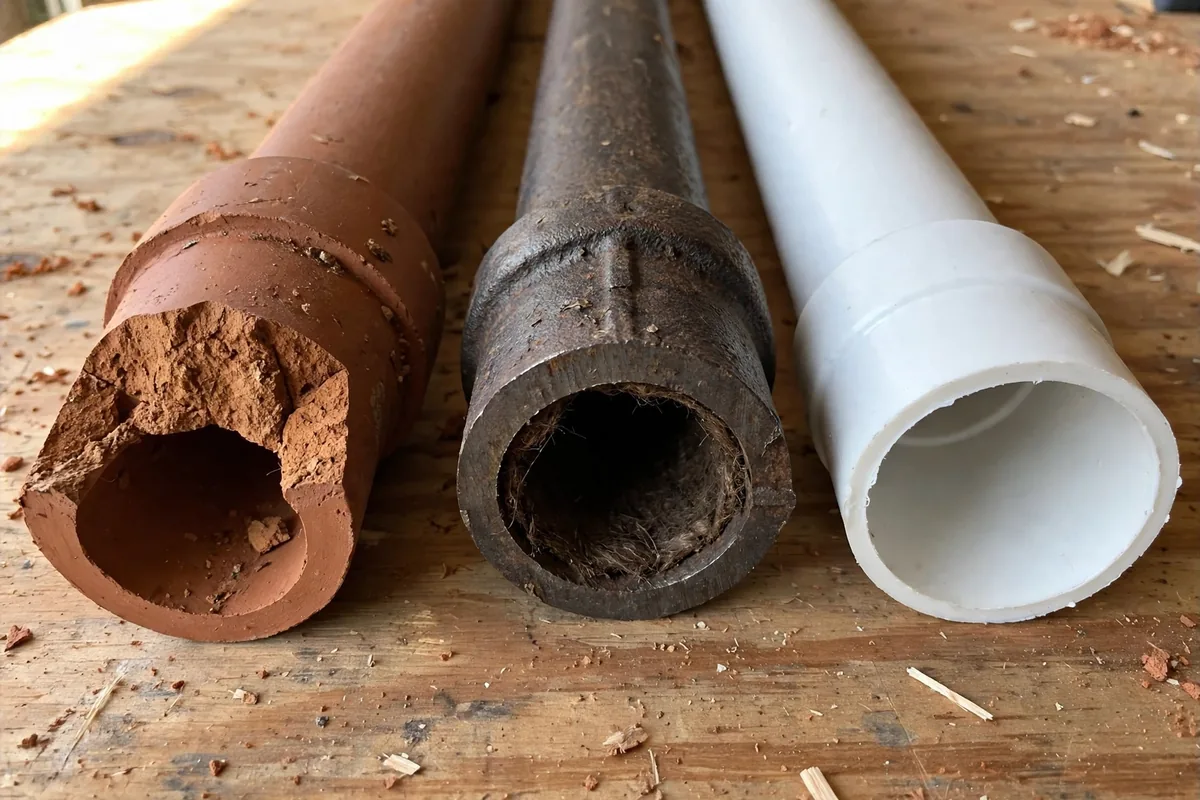
The fired clay option was laid in short lengths, which is its strength and its weakness at once. The material itself barely changes underground, but every joint is a seal that ages, shifts and can open a little. Roots slip in at those joints, soil can wash through a gap, and one settled section can throw the fall of the whole run out. A vitrified clay pipe with sound joints can serve for decades; the same pipe with open joints is a recurring repair.
Concrete pipe turns up more on larger runs and older shared sections. It carries heavy loads well, but the inside face can slowly erode where flow is constant, leaving a rough surface that catches waste and narrows the opening. Repairs tend to focus on joints, cracks and surface loss rather than on the material suddenly failing all at once.
For both, the repair picture is similar: the walls are often sound while the joints cause the trouble. That favours sealing, lining or short section repairs over full digging, as long as the line still holds its shape and fall. Homeowners comparing options for sewer line repair in Alliance, OH often find their older rigid line needs joint work, not a complete new run.
What Happens To Iron And Fibre Lines As They Get Older?
Cast iron pipe usually fails from the inside, as steady corrosion thins the bottom of the pipe until it grooves, flakes or opens. The fibre-based material fails differently: it softens, blisters and loses its round shape.
Pipe corrosion and scaling build up on the inside of the iron option over decades. The rough scale catches waste, and channeling wears a groove along the bottom where water runs, until the wall there is paper thin. Early on, a scaled line can sometimes be cleaned back and lined. Once the bottom has rusted through, cleaning only reveals holes, and that section needs replacing rather than restoring.
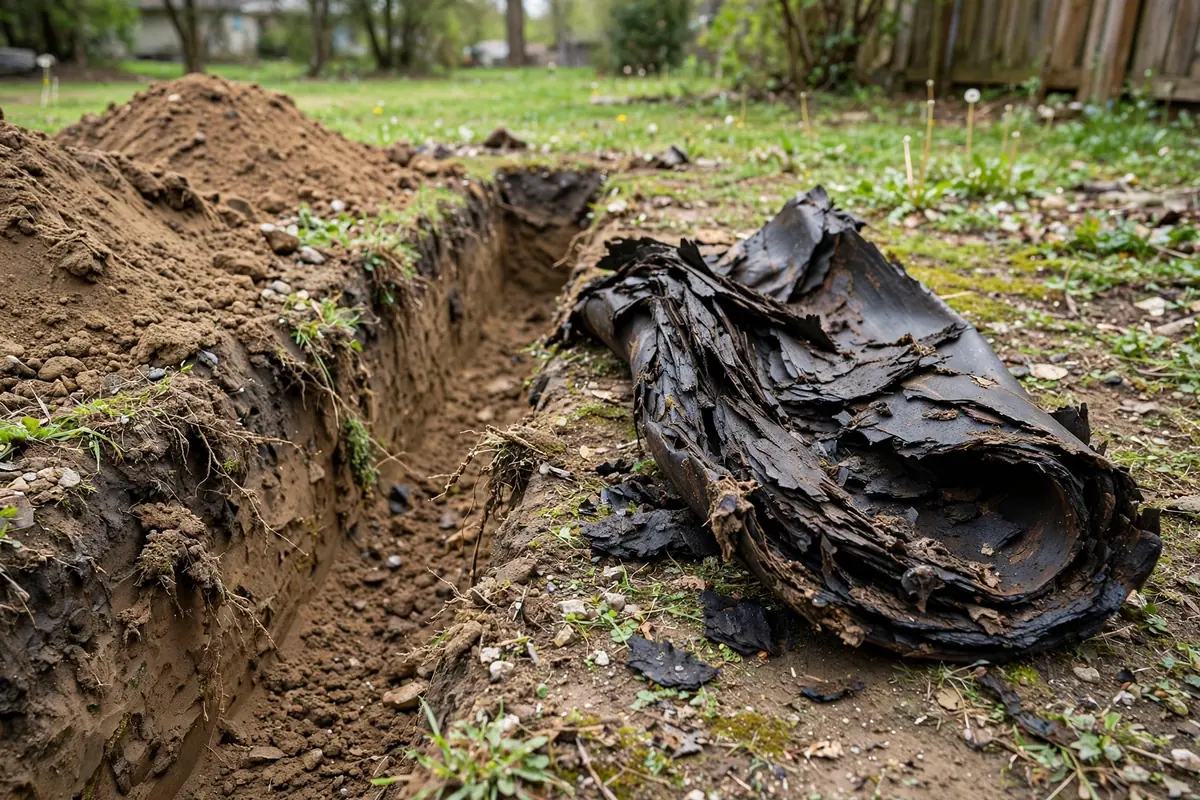
Orangeburg pipe is the fibre-based outlier: layers of fibre and tar pressed into a tube, with no rigid strength of its own once it ages. Orangeburg deterioration shows as blistering, flaking layers and a pipe that has slowly gone oval under the weight of the soil. Roots and cleaning tools can tear the softened wall, which is why it is handled more gently than any other material on this page.
The practical split is this. Iron that still has wall thickness can often be descaled, lined or repaired in sections. A fibre line that has lost its shape rules lining out, because a liner needs a round host to form against, so replacement is usually the honest answer. That is the position many owners reach with sewer line repair in Allentown, PA, where both materials survive in older streets.
How Do The Two Modern Plastic Lines Differ From Each Other?
PVC pipe is rigid, light and joined in sealed sections, so it keeps a smooth inside and gives roots few openings. HDPE pipe is flexible and can be fused into one continuous run with no joints along its length.
The rigid plastic is the standard choice for open digging work. Its smooth walls let waste pass cleanly, the joints seal with gaskets or solvent welds, and cut lengths are easy to fit around existing runs. Thickness still matters within the family, which is why our guide on SDR 35 vs Schedule 40 sewer pipe compares the two common grades side by side, including where each one belongs. A PVC pipe section can also be joined into an older line during a part replacement.
The flexible plastic earns its place where the ground moves or the run is long. Because sections are heat-fused together, the finished HDPE pipe behaves like a single piece: no joint seals to age, and the pipe can flex a little with soil movement instead of cracking. Those same fused joints make it the usual pipe pulled through during bursting work.
Neither is immune to poor fitting. Any plastic line bedded badly can settle into a low spot, and any line laid without proper slope will drain badly whatever it is made of. Material sets the ceiling; the fitting decides whether the line reaches it, a point that comes up across sewer line repair across Ohio whenever a fairly new line still performs badly.
Does Your Material Decide Whether Lining, Bursting Or Digging Is Possible?
Largely, yes. Lining needs a host that is still round and holding together, bursting can work through most old materials, and digging is the fallback that every material allows when the line has collapsed or lost its shape.
Cured-in-place pipe lining (CIPP) forms a new pipe inside the old one. The CIPP liner is pulled or pushed into place, pressed against the host wall and hardened, sealing joints and small cracks along the covered stretch. It suits older rigid lines whose walls and shape remain, and it cannot rescue a host that has gone oval or caved in, because the liner simply takes the host's shape. Spot excavation repair covers the opposite case: one short failed length, dug and replaced on its own.
Pipe bursting takes a different route. A bursting head is pulled through the old run, splitting the old pipe outward while drawing the new fused pipe in behind it. Because the old pipe is broken rather than reused, its condition matters far less, which makes the method a strong option for brittle or softened lines that lining cannot help. It does need access pits at each end and room in the ground around the run.
Open-trench replacement remains the method that always works, including for a fully collapsed line, at the cost of the most digging and surface repair. Where a new section meets a different older material, a Fernco flexible coupling makes a tight, sealed joint between the two. Runs passing close to the foundation need the most care with any digging method, since soil support there matters to the home above.
What Decides The Cost Of Working On Each Material?
The bill turns on the material, its condition, and the ground around it, never on one flat figure. Depth, length, access, the method the material allows, and what has to be put back on the surface shape the quote most.
Start with condition. A line with sound walls and open joints offers cheaper sealing and lining choices. A cracked or collapsed pipe closes those choices off and pushes the work toward digging, which adds excavation, haul-away and surface repair. A single offset joint, by contrast, can sometimes be fixed with one small dig, which is why the camera findings move the price more than the material name alone does.
Access and distance come next: how deep the line sits, how far it runs to the public sewer main, and whether it passes under a driveway, path or planting that must be restored. Prevention also belongs in the cost picture. Reading how to prevent tree roots in sewer line shows why scheduled care on a jointed older line costs less over time than repeated emergency clearing.
Method is the last lever, and your material partly chooses it for you. Where lining or bursting is possible, avoiding a full trench usually trims the digging and restoration share of the bill. Where it is not, honest comparison means comparing digging quotes on the same scope of work, a point worth remembering across sewer line repair across Pennsylvania as much as anywhere else.
When Is Full Replacement A Better Call Than Another Repair?
When failures repeat in different places, when the line has lost its shape, or when each repair buys less time than the last one. At that point the material itself is spent, and another patch only delays the same decision.
Look at the pattern, not the latest blockage. One bad joint is a repair. Roots, cracks or scaling appearing at several distances along the run, shown on the same set of footage, describe a line failing as a system. Replacing that line in a modern material removes the joints and weak walls together, instead of funding them one visit at a time.
Shape is the second test. A host that has gone oval, flattened or caved in cannot be lined and will not drain properly even when clean. Replacement is also the plainer choice where a failing line runs under a surface you plan to renew anyway, because the digging and the resurfacing can be done once, together, instead of twice.
If your footage shows that pattern, one free call connects you with an independent local pro who can walk through the sections on camera and price repair against replacement honestly. A pro can typically arrive in 30–60 minutes, and calls are answered 24/7. Keep the footage either way: a documented new line, or a documented repair, is proof of condition for insurers and for anyone who buys the home later.
Frequently Asked Questions
Short answers to the questions people ask most about pipe materials and repair choices. If your question is not here, call free and ask — lines are answered 24/7.
Still Have Questions? Call Free
One free call connects you with a local pro.
(800) 555-0100Free Call · Answered 24/7 · No Obligation
Reviewed By Hamza
Master Plumber & Trenchless Sewer Rehabilitation Specialist
Hamza is a licensed master plumber and underground infrastructure specialist with extensive field experience resolving sewer lateral collapses, root intrusions, and structural line offsets across Pennsylvania, Ohio, and New York. He specializes in high-definition CCTV pipe diagnostics, cured-in-place pipe (CIPP) lining, pipe bursting, and non-invasive trenchless rehabilitation to restore residential and commercial sewer systems without property destruction.
Updated October 31, 2026
Need Sewer Line Repair Near Me?
One free call connects you with an independent local pro — answered 24/7, no obligation.
Call (800) 555-0100Free Call · Answered 24/7 · Local Pros Near You