Why a Good Sewer Repair Adds a Cleanout - and Where It Goes
Free Call · Answered 24/7 · Local Pros Near You
The Short Answer
Adding a cleanout while a sewer line is already open for repair is the cheapest moment to gain permanent access to the pipe. The trench is dug, the line is exposed, and fitting a capped access point takes a pro a short time compared with excavating later. A well-placed cleanout lets future camera checks and clearing work start from the yard instead of through the house. One free call connects you with an independent local pro to plan it.
Call (800) 555-0100Install Sewer Cleanout During Repair, Explained In Plain Words
Why Is Repair Time The Easiest Moment To Add A Cleanout?
Because the expensive part is already done. The yard is open, the pipe is exposed and the crew is on site, so adding a capped access fitting is a small extra step now and a whole excavation on its own later.
Most of the cost of fitting a cleanout on a finished yard is digging: opening the ground, working safely around other buried lines and putting the surface back. During a repair in Altoona, PA, sewer line repair work, that digging has already happened for the repair itself, so the fitting rides on work you are already paying to have done.
There is a second advantage: the pro can see the whole exposed run before choosing the spot. Pipe material, depth and direction are visible rather than guessed from a camera, and the fitting can be set where it will actually be reached later. The same logic holds across the state — see sewer line repair in Pennsylvania for how repairs are usually scoped.
Skipping the chance usually means paying twice. Homeowners who decline often meet the idea again at the next blockage, when the crew has no outside access and the only routes in are through the house or a fresh dig. A short conversation while the trench is open is the moment to avoid that repeat bill.
What Exactly Is A Cleanout Fitting?
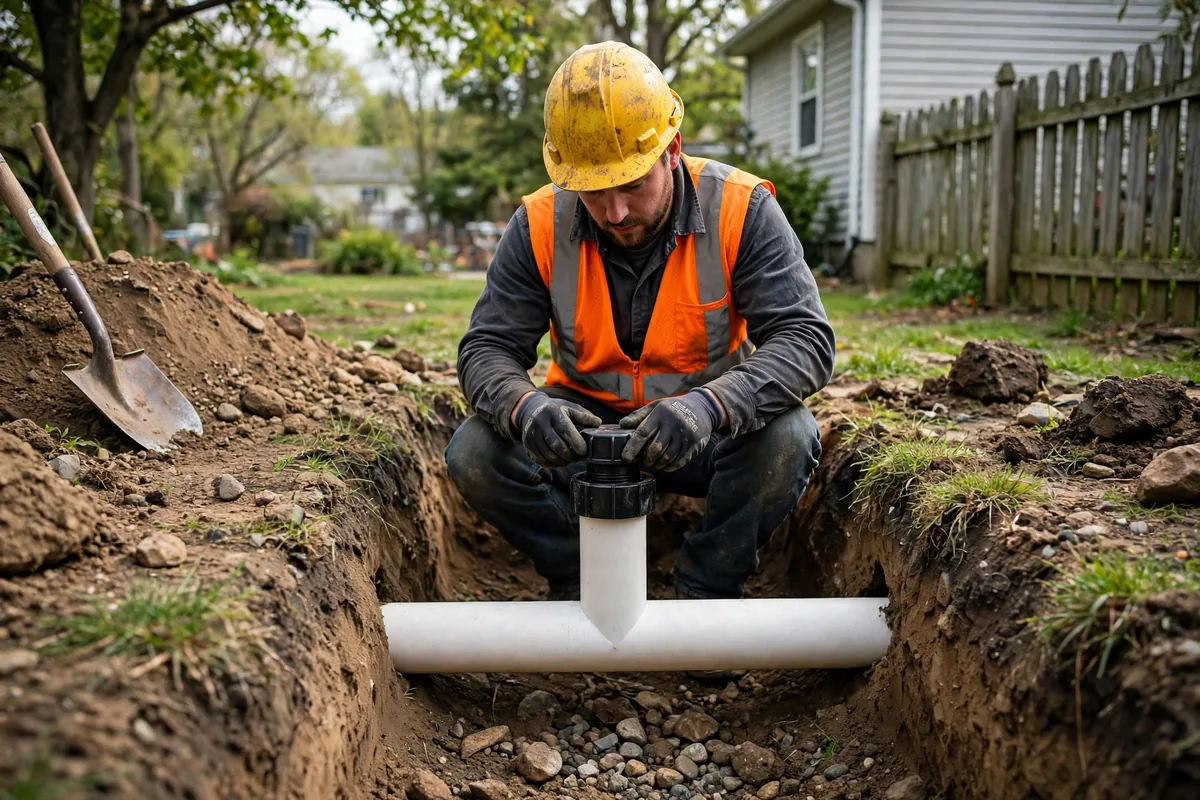
It is a capped opening built into the line: a short riser rises from the pipe to a removable cap at or near ground level. Unscrew the cap and the pipe is open for cameras, cutters and jetting without entering the home.
The fitting itself is simple. A wye or sweep branch is set into the run, a riser pipe climbs from it, and a threaded cap closes the top. Modern work usually uses PVC pipe for the riser and cap because it does not rust, the threads stay workable for decades, and the cap can be opened by hand or with a simple wrench.
On an older line the new section has to meet what is already buried. Where a plastic fitting joins a vitrified clay pipe or a cast iron pipe, the pro uses a shielded Fernco coupling sized to both materials, so the joint stays aligned and sealed as the ground settles around it.
Height is a small detail with long consequences. Caps are usually finished flush with the soil or a few inches above it inside a small access box, so a mower passes safely and the cap does not become a trip point. A cap buried deep under mulch or soil is a cap nobody can find in a hurry.
Where Does An Outdoor Cleanout Usually Go?
The usual spot is just outside the home, close to where the line leaves the building, so one opening reaches both the house plumbing and the run to the street. Exact placement follows depth, direction and what else crosses the yard.
Outside the foundation is the classic position: the line is still shallow there, the route to the street is straight, and a crew arriving at night can find the cap without crossing planting or patios. In Amsterdam, NY, sewer line repair work on older streets, that spot is often the only stretch of the run not covered by later paving.
Before the spot is fixed, the pro confirms the route and depth. A camera carrying a sonde locator lets the crew pinpoint the pipe from above ground and mark the line on the grass, so the fitting lands on the pipe itself rather than on a guess beside it.
Other buried services shape the choice too. Before digging, the crew's call 811 check has water, gas and electric lines marked, and the cleanout should sit clear of them and clear of the right-of-way at the street edge unless the town asks for a property-line fitting there.
What Is A Two-Way Cleanout, And When Is It Worth Fitting?
A two-way fitting carries two sweep branches back to back, so tools can be sent toward the house or out toward the street from one cap. It suits long runs and lines where trouble has appeared in both directions.
With a single-direction fitting, access favours one way. A camera pushed the other way fights the sweep of the branch and may not pass at all. The two-way design removes that limit, which matters when the run from cap to public sewer main is long or when roots have been found at more than one point along it.
Homes in Athens, OH, sewer line repair areas with mature trees on both sides of the line are a fair example: roots enter near the house and again near the street, and one two-way opening lets a crew clear and film both stretches in a single visit.
The extra fitting costs a little more in parts and setting time — factors like depth, pipe size and how much of the run is already open decide the difference. Ask the pro to explain, for your yard, whether one direction covers every likely job or whether the second sweep earns its place.
Can A Cleanout Go Indoors Instead Of In The Yard?
Yes, where the layout suits it. An indoor fitting at the base of the main stack gives dry, all-weather access, and some older homes already have one there or at a house trap. Outdoor access is still preferred when the trench allows it.
Basements and utility rooms are the usual indoor spots. A cap at the foot of the main stack lets a camera enter the buried run directly, and the work stays clean because clearing equipment is not dragged through living rooms to reach a toilet or a floor drain.
Many older houses rely on a house trap just inside the cellar wall, and its caps were the original access point. Traps clog, corrode and date the system, so when a repair opens the line outside, most pros take the chance to give the home a modern outdoor opening and leave the trap route as a backup rather than the only way in.
Choose indoors when the yard route is blocked by an extension, a porch or paving that cannot be disturbed, or when the line leaves through a party wall. Choose outdoors when you can: a backup cleared from the yard keeps mess outside the home, as our guide to sewage backup cleanup safety explains in detail.
How Does A Cleanout Change Future Inspections And Clearing?
It turns every future visit into outdoor work. A camera enters at the cap, clearing tools follow the same route, and nobody needs to remove a toilet, open a roof vent line or carry equipment through the house.
A CCTV sewer camera inspection run from a yard cap is quicker to set up and easier to repeat, so comparing this year's footage with last year's becomes realistic. Repeat checks are how slow problems — a joint opening year by year, roots thickening at one seam — get caught while a small fix still works.
Clearing improves the same way. Mechanical root cutting and jetting both start at the cap and work outward, and chain descaling for a rough, scaled line can be run from the same opening. Owners in Abington, PA, for sewer line repair with older metal lines use that access for planned cleaning instead of emergency calls.
The cap also helps diagnosis before anyone digs. When drains slow again, a pro can open the fitting, see whether the blockage sits on the house side or the street side, and test the run with a smoke check — our page on sewer smoke testing shows how that second test reads the line. Ten minutes at the cap can save an afternoon of guessing.
Which Repair Methods Pair Naturally With A New Cleanout?
All of them, because each method leaves the line renewed but still in need of future access. The fitting is method-neutral: it serves a lined, burst or newly dug line exactly the same way for the rest of its life.
With cured-in-place pipe lining (CIPP), the liner is often installed through an access point, and a purpose-built cleanout gives the crew a straight, correctly sized entry instead of a makeshift one. The finished cap then becomes the entry for the post-work camera check that proves the liner seated correctly.
Pipe bursting pulls a new pipe through the old run from an entry pit, and a cleanout fitted over the new line gives that line its first proper access point. With open-trench replacement, the fitting is simply built into the new run as it is laid, and with a spot excavation repair it can be set over the renewed section so that one stretch never needs digging again for access.
Whichever method your repair uses, the new section must keep the proper slope so water cannot pool at the fitting or anywhere along the renewed run. Renew the pipe once, and leave an opening that makes every later job smaller: that pattern holds whatever method brought the crew to your yard. If you are weighing a repair now, one free call connects you with an independent local pro who can typically arrive in 30–60 minutes, and lines are answered 24/7.
What Should You Agree Before The Trench Is Filled, And How Do You Look After The Cap?
Agree the cap position and finish height before soil goes back, get the location recorded, then keep the cap findable afterwards. A few minutes of care each year keeps the fitting ready for the night it is needed.
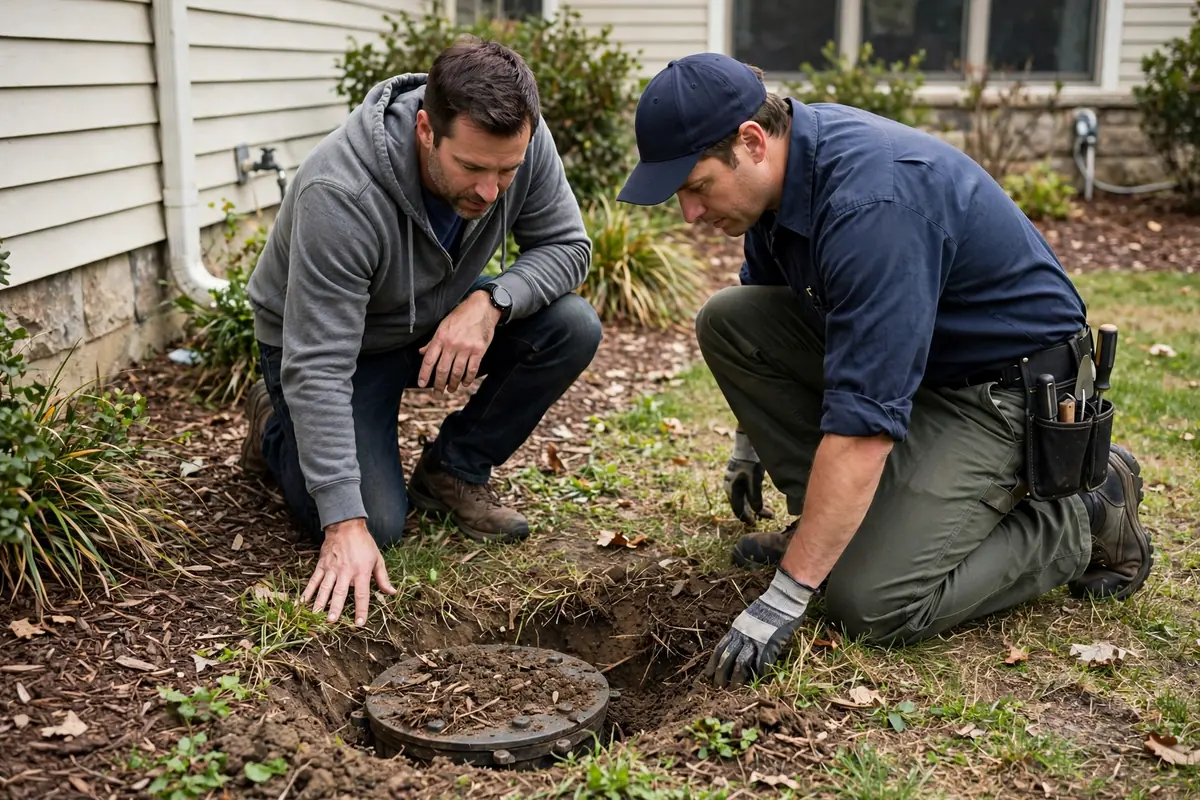
Walk the yard with the pro and stand where the cap will sit. Check that a mower clears it, that it is not under a future path or planting, and that you could find it in the dark during a backup. If a backwater valve is being fitted in the same trench, agree its position in the same walk-round, since both items need to stay reachable.
Records matter as much as position. Ask for the cleanout location, depth and direction to be written into the sewer inspection report and footage notes from the repair, with a photo of the open fitting before backfill. Those records also support any later claim paperwork — our guide to sewer line insurance coverage shows which documents insurers ask for, and the habit matters as much in sewer line repair in Ohio as anywhere else.
Afterwards, treat the cap like a small piece of infrastructure. Keep soil and mulch below the rim, strim rather than mowing over a raised cap, and check once a year that the threads still open freely. If landscaping changes the level of the yard, have the riser adjusted rather than letting the cap vanish, because a fitting nobody can find cannot do its job.
Frequently Asked Questions
Practical answers about adding a cleanout during a repair — where it goes, what it changes and how to keep it usable. If your line is open now or a repair is booked, one free call connects you with a local pro, answered 24/7.
Still Have Questions? Call Free
One free call connects you with a local pro.
(800) 555-0100Free Call · Answered 24/7 · No Obligation
Reviewed By Hamza
Master Plumber & Trenchless Sewer Rehabilitation Specialist
Hamza is a licensed master plumber and underground infrastructure specialist with extensive field experience resolving sewer lateral collapses, root intrusions, and structural line offsets across Pennsylvania, Ohio, and New York. He specializes in high-definition CCTV pipe diagnostics, cured-in-place pipe (CIPP) lining, pipe bursting, and non-invasive trenchless rehabilitation to restore residential and commercial sewer systems without property destruction.
Updated October 31, 2026
Need Sewer Line Repair Near Me?
One free call connects you with an independent local pro — answered 24/7, no obligation.
Call (800) 555-0100Free Call · Answered 24/7 · Local Pros Near You